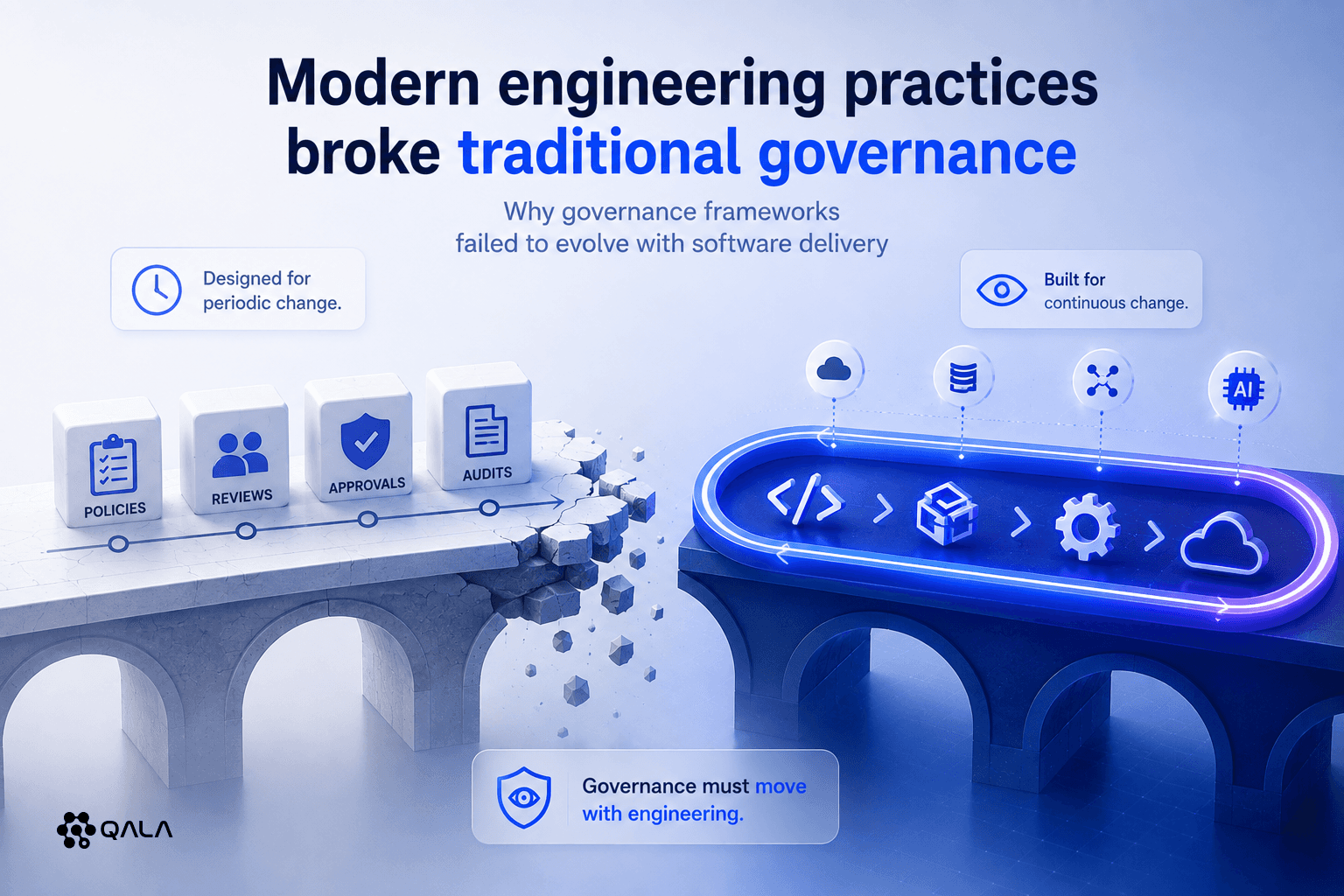
Why organisations often assume controls are functioning
For years, the market has invested heavily in governance frameworks, compliance programmes, and control environments designed to reduce risk and demonstrate accountability. As a result, Policies are well documented and controls defined together with all the assignment of responsibilities. When the time comes, evidence is collected so that audit reports can be produced.
This is critical as a lot of the information and knowledge is in different sources, documents, people or tools. On paper, everything appears under control.
Yet, one of the most significant governance risks today starts from a simple assumption – because a control was designed correctly and has proven to be robust for many years, it must still be functioning as intended.
This assumption is becoming increasingly dangerous.
The comfort of documented controls
Most governance programmes are built around intent and policies states how sensitive data should be handled. Frameworks and standards define required controls that lead to business process to outline responsibilities. Certification and audit validate that controls are in place and exist.
Finally, the organisation can conclude that risk is being managed appropriately, and this approach has been proven it was largely sufficient where technology environments changed relatively slowly. Applications were deployed infrequently, infrastructure was stable and the data remained within well-defined boundaries.
There was a reasonable expectation that a control reviewed six months ago would continue operating in much the same way today.
That assumption no longer holds.
Modern systems change continuously
Today, we operate in environments defined by constant change, being that engineering teams that deploy new code daily, cloud infrastructure that evolves continuously, third-party integrations that appear and disappear, APIs that connect systems dynamically or even AI introducing entirely new execution paths. Data moves across environments that did not exist only months before.
In this context, governance cannot rely solely on the assumption that controls remain effective simply because they were effective at a previous point in time.
The challenge is no longer whether controls were implemented correctly. rather if whether they remain effective today.
The growing gap between governance intent and operational reality
The market has only now started to realise the challenges and problems of the current model where governance intents are documented, and the operational relativity is dynamic leading to continuous drift.
A policy may state that customer information must remain within approved systems. Yet a newly deployed integration may expose data to an external service.
A control may prohibit regulated information from entering AI systems. Yet employees may begin using new AI tools or workflows that were never considered during the original risk assessment.
A governance framework may require data classification standards. Yet engineering changes may introduce entirely new data flows that bypass existing controls.
None of these scenarios necessarily represent failures in governance design. They represent failures in governance visibility.
Controls without verification become assumptions
The uncomfortable reality is that many organisations cannot confidently answer fundamental questions, and some might even think they shouldn’t:
· Are sensitive data controls operating as intended today?
· Has data exposure changed since the last review?
· Are third-party integrations behaving as expected?
· How are AI systems interacting with regulated information?
· Where has operational drift emerged?
In fact, without continuous verification, answers to these questions become assumptions rather than evidence. And assumptions create risk.
This is particularly relevant as governance failures are rarely discovered in real time, they are typically identified during audits, regulatory reviews, security incidents, or post-breach investigations.
In other words, organisations often discover governance failures long after the underlying behaviour began.
Why compliance can create a false sense of security
Perhaps the greatest challenge is that being compliant was or still is a checkbox exercise for many and others appear to be compliant while lacking meaningful visibility into operational behaviour.
Although controls, documentation and evidence exist, most have still little to no understanding of what is actually happening within operational systems. This creates the dangerous illusion of being compliant by design.
The organisation becomes increasingly confident in the existence of controls while becoming increasingly disconnected from their real-world effectiveness.
Compliance therefore becomes a measure of documentation rather than a measure of operational reality.
The future requires continuous validation
The next generation of governance must require a different mindset. Organisations will still need policies, require standards and conduct audits but these activities alone are no longer sufficient.
Governance must increasingly evolve towards continuous validation. Not simply proving that controls were designed but continuously verifying that controls remain effective as systems, data flows, and AI-enabled processes evolve.
The future belongs to organisations capable of continuously reconciling governance intent with operational reality.
The question is no longer whether a control was implemented correctly.
The question is whether it is still working.
And only evidence can answer that.