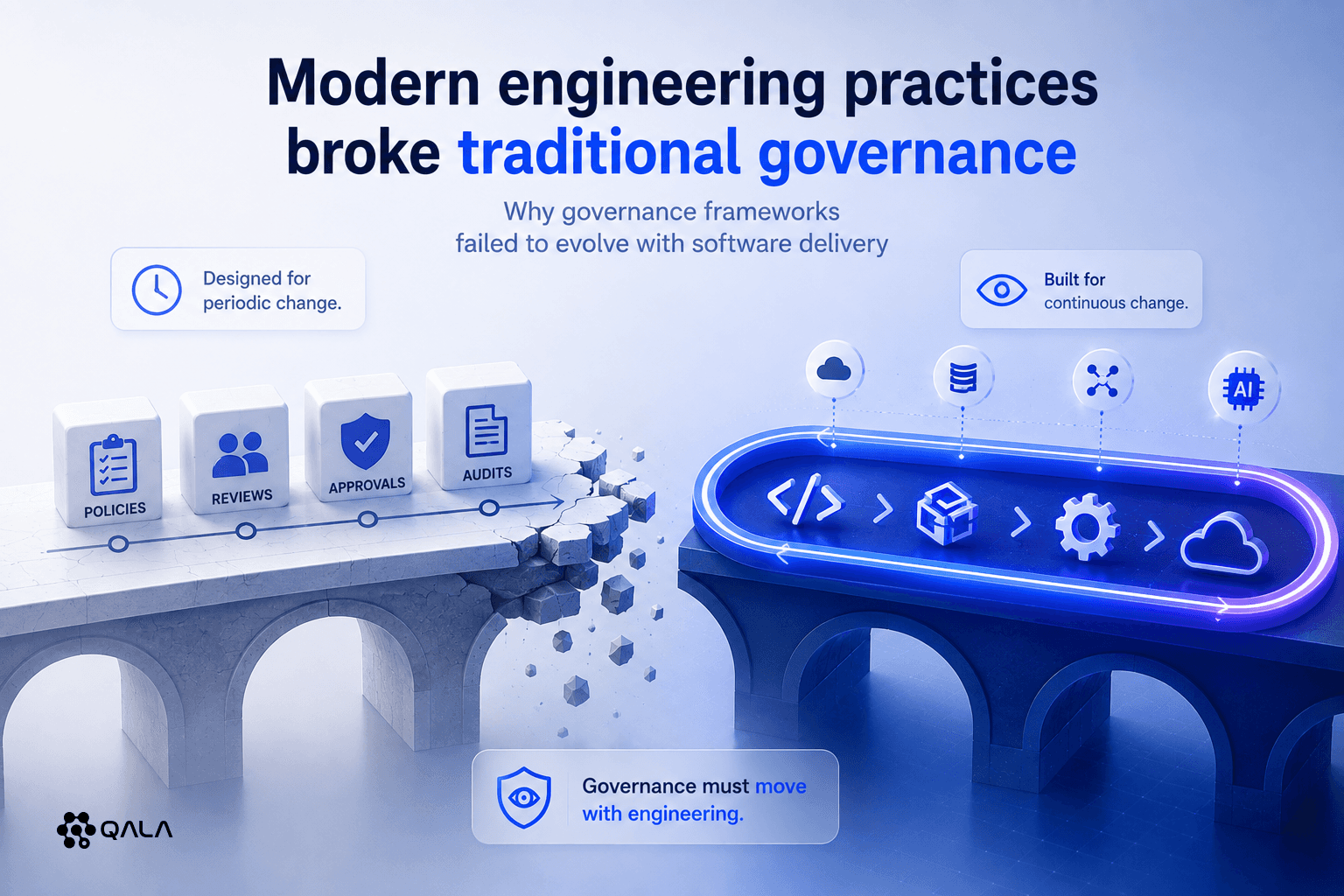
The case for embedding governance into development workflows
Governance has traditionally operated alongside engineering. Engineering built systems and governance reviewed them. Followed by security and compliance to validate and document them. Each discipline performed its own role.
This separation worked when software evolved slowly, today’s engineering world requires something very different. Governance must become part of the engineering process itself.
Governance should begin where software begins
Most governance activities still happen after decisions have already been made and they are often found with architecture reviews, control validation, evidence collection or compliance assessments.
By the time these activities begin, engineering has often moved on. This is what needs to change – governance needs to move much closer to the source.
Where software is designed, data models are created, APIs are defined, AI capabilities are introduced – directly at the source code.
Governance becomes significantly more effective when it starts alongside engineering rather than after delivery.
Engineering already proved the model
Engineering has experienced this transformation before, the shift left.
Testing shifted left;
Security shifted left;
Infrastructure became code;
Automation became standard.
Every one of these changes reduced friction while improving quality and speed.
Governance is now entering the same transition, rather than slowing engineering, it becomes part of engineering itself.
Governance should not create more work
The biggest concern surrounding governance is that stronger oversight creates additional process, documentation, approvals and meetings – and this would slowdown engineering.
Modern governance should achieve the opposite.
It should reduce manual effort by generating visibility directly from engineering systems where evidence emerges naturally from operational behaviour - not through manual reconstruction.
Operational truth becomes the source of governance
Engineering systems already describe how software behaves.
Code defines logic;
Schemas define data;
APIs define interactions;
Runtime reveals operational reality.
Modern governance should build upon those sources of truth and not recreate them elsewhere.
Governance becomes continuous by design
Embedding governance into engineering fundamentally changes how organisations operate, as:
Controls are continuously verified;
Data movement becomes visible;
Governance drift is detected early;
Evidence is generated automatically.
Governance stops being an activity and it becomes an operational capability.
The future belongs to engineering-native governance
Engineering is no longer waiting for governance to catch up, governance must evolve alongside engineering.
The organisations leading the next generation of software delivery will not treat governance as an external function - they will build it directly into the engineering lifecycle.
Governance should move at the speed of code.