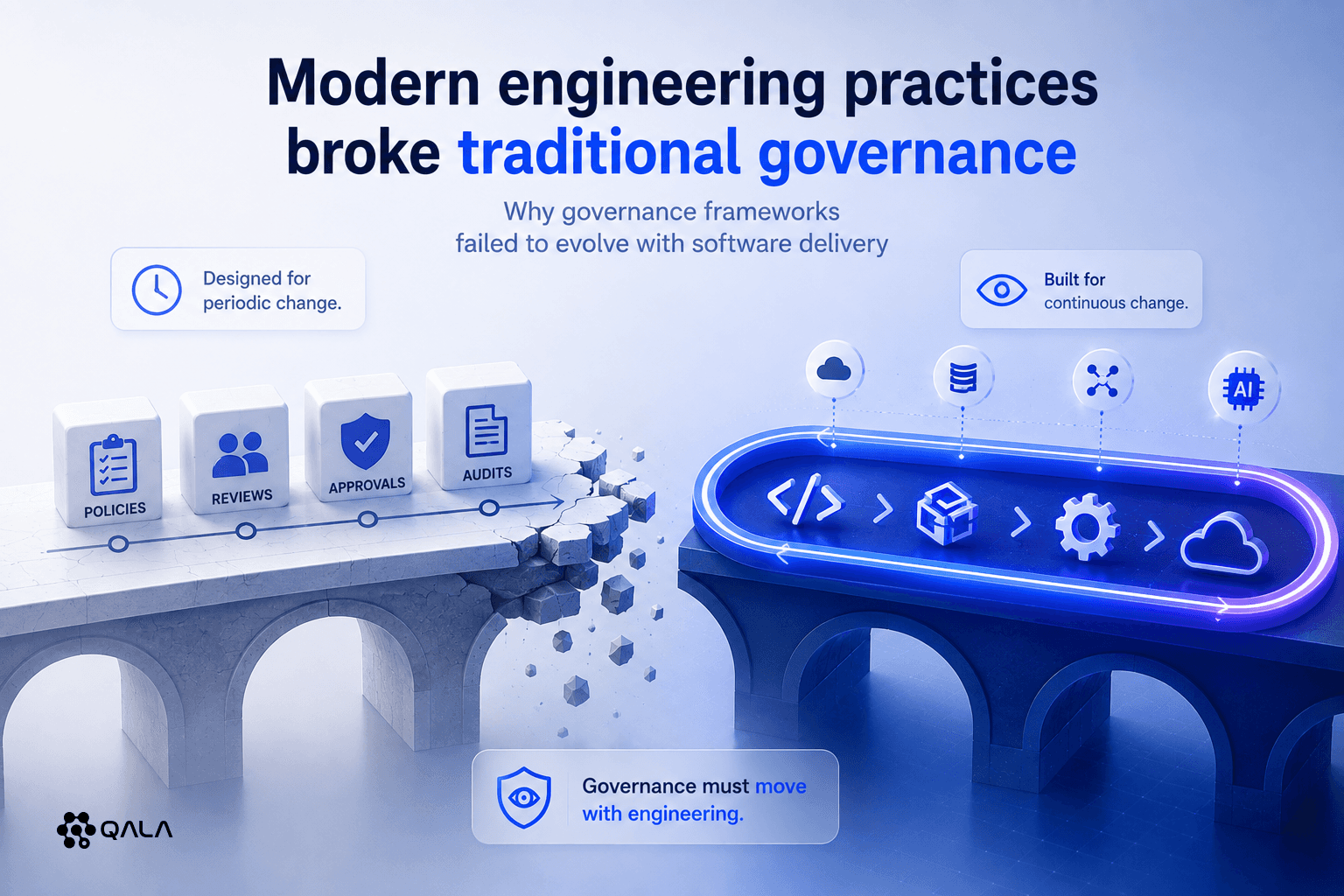
How operational speed fundamentally altered control assumptions
DevOps transformed software engineering and AI is transforming governance. Although these are different, they share something important - both dramatically increased the speed at which operational environments change.
DevOps automated infrastructure and turned it into software - AI is automating decisions. Together, they are redefining what governance must become.
DevOps changed how systems evolve
Before DevOps, infrastructure was relatively predictable – changes, configurations, envirnmoments – over time, DevOps fundamentally changed these assumptions.
Infrastructure became programmable, deployments continuous, environments evolved automatically so that engineering teams could gain unprecedented speed.
Governance largely continued operating through periodic validation.
AI changed operational behaviour
AI introduces a different change type, instead of accelerating infrastructure alone, it accelerates how information is accessed, processed and shared.
Operational behaviour becomes increasingly dynamic with new models appearing, AI assistants interacting with enterprise systems or autonomous agents coordinating workflows.
Governance now faces complexity that extends well beyond infrastructure, it must understand how data behaves.
Traditional controls assumed stability
Since most governance controls were designed around environments that changed gradually, a control could be implemented, validated, documented and reviewed months later. The issue is that today, environments envolve after controls have been approved and previous assimptions no longer reflect operational reality.
The question therefore changes, from "Was this control implemented correctly?" to "Does this control remain effective today?"
Speed changes governance itself
The challenge is not simply keeping pace with engineering. Governance itself must become operational and continuously understand:
How data moves.
How AI behaves.
How integrations evolve.
How controls drift.
This requires a fundamentally different operating model. Not to make engineering slower but to have a governance that can be at the speed of engineering.
Continuous observation replaces periodic certainty
Leading organisations increasingly recognise that governance cannot depend on historical evidence alone.
Operational confidence now comes from continuous observation where visibility replaces assumptions, verification replaces declarations and evidence becomes a continuous operational output.
AI is accelerating governance evolution
AI did not create the need for better governance, it is accelerating an existing structural weakness.
The organisations best prepared for the future will not simply govern AI, they will fundamentally rethink governance itself.
Because AI changed far more than technology, it changed the pace at which governance must operate.