Why traditional control frameworks cannot keep pace with AI workflows
Artificial Intelligence is not simply introducing another technology for organisations to manage, it is fundamentally changing how organisations operate.
The reality today is that across almost every industry, AI is being embedded into business processes, software development, customer interactions, decision-making, data analysis and operational workflows. New AI capabilities are being released at a fast pace and adopted faster than governance teams can understand them, let alone govern them.
This is creating a challenge that many are only beginning to recognise. The pace of AI adoption has overtaken the pace of traditional governance and as a result, the gap between operational reality and governance visibility is growing.
Governance was built for predictable systems
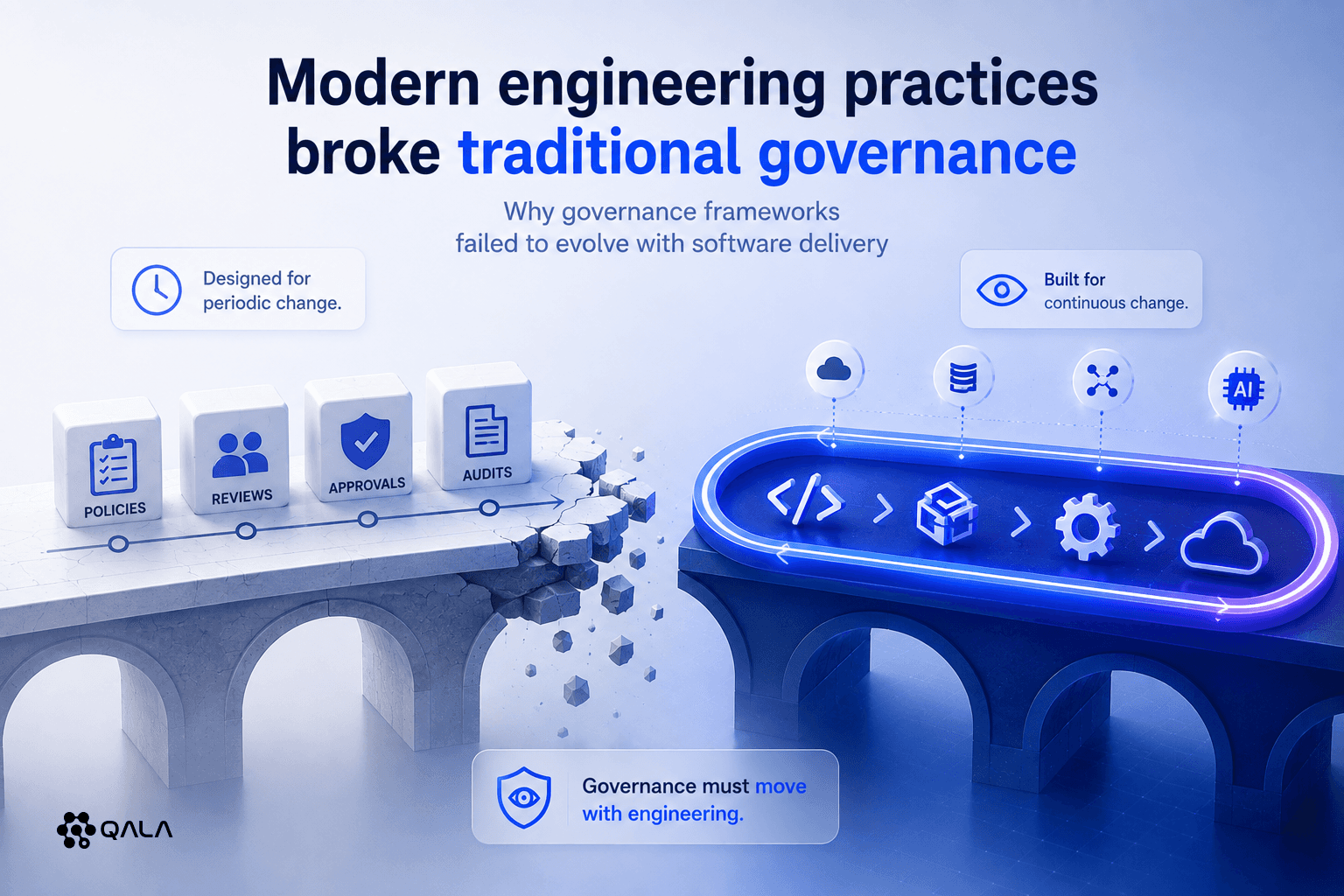
When looking at the well known traditional governance frameworks, they were designed around environments that changed at a manageable pace. Where applications evolved through planned releases, the infrastructure changed through controlled processes and its data followed relatively predictable paths.
Governance reflected this reality and policies defined acceptable behaviour. Their controls were implement and reviews validated compliance time to time. The audits could then confirm that governance processes remained effective.
The underlying assumption was simple.
Operational decisions and behaviour changed slowly enough that governance could periodically assess it and still maintain confidence. AI changes that assumption completely.
AI changes operational behaviour continuously
Unlike traditional human-driven software development, AI systems are inherently dynamic.Being that because new models are introduced or existing models are retrained. Prompt engineering evolves and system integrations expand. The data sources change and autonomous agents interact with multiple systems without direct human involvement.
None of these activities happen in isolation.
This continuously influence how sensitive data is accessed, processed, shared and transformed, creating operational behaviours that rarely remain static and hard to keep control. While governance continues to operate through static validation.
That mismatch is becoming increasingly difficult to manage.
AI introduces governance challenges that policies alone cannot solve
Most organisations have responded to AI by writing policies, from:
Responsible AI policies.
Acceptable use policies.
AI governance frameworks.
Risk assessments.
These are important, yet documentation alone does not provide governance.
While a policy may prohibit sensitive information from being used within external AI services, it does not demonstrate whether it actually happens.
The same way, an AI governance framework may define approval processes but it does not verify how AI systems interact with enterprise data once deployed.
Governance increasingly requires visibility into operational behaviour rather than confidence in documentation.
AI workflows rarely stay where they started
One of the biggest governance challenges introduced by AI is that workflows evolve rapidly. A single AI-enabled process may begin as an internal productivity tool and within weeks it becomes connected to customer data – soon afterwards it integrates with external platforms, additional models are introduced, new APIs appear and third parties gain access.
What was originally considered low risk becomes business critical.
All these changes often happen incrementally and traditional governance rarely observes them in real time.
Control frameworks struggle to keep pace
Since most governance controls remain retrospective, evidence is collected periodically and controls are reviewed on scheduled cycles – compliance is assessed against historical snapshots. Meanwhile, AI environments continue changing every day, creating an uncomfortable reality.
As a result, organisations may be fully compliant with yesterday's operational environment while having very little visibility into today's.
The issue is not necessarily that controls are poorly designed, it is that the environment they govern now changes continuously.
Visibility becomes the new control
As AI accelerates operational complexity, visibility becomes increasingly important. Governance teams now need to understand far more than whether policies exist.
They need to understand:
Which AI systems interact with sensitive data.
Where data flows during AI processing.
Which third parties become part of AI workflows.
How new integrations change exposure.
Whether operational behaviour continues to align with governance expectations.
These questions cannot be answered through documentation alone, they require continuous operational visibility.
Governance must evolve alongside AI
The future of AI governance will not be built around more paperwork or will be achieved through larger policy libraries or increasingly complex approval processes.
Instead, governance must become operational moving closer to runtime.
This means continuously observing how data and AI systems behave rather than periodically reviewing how they were designed. Having a continuous validation of controls rather than assuming them and verifying data handling rather than relying on declarations.
Most importantly, it means building governance that evolves at the same speed as the technology it is designed to oversee.
The future of AI governance is operational
AI is not slowing down and teams are finding ways of increasing usage and becoming more efficient. Security leaders increasingly recognise that governance can no longer rely on periodic evidence collected after change has already occurred, it must become continuous.
In summary, to be best prepared for AI the solution will be to build greater operational visibility rather than creating more governance frameworks.
AI is moving faster than governance was designed for and the future belongs to organisations capable of governing AI as it actually operates, not as they assume it operates.