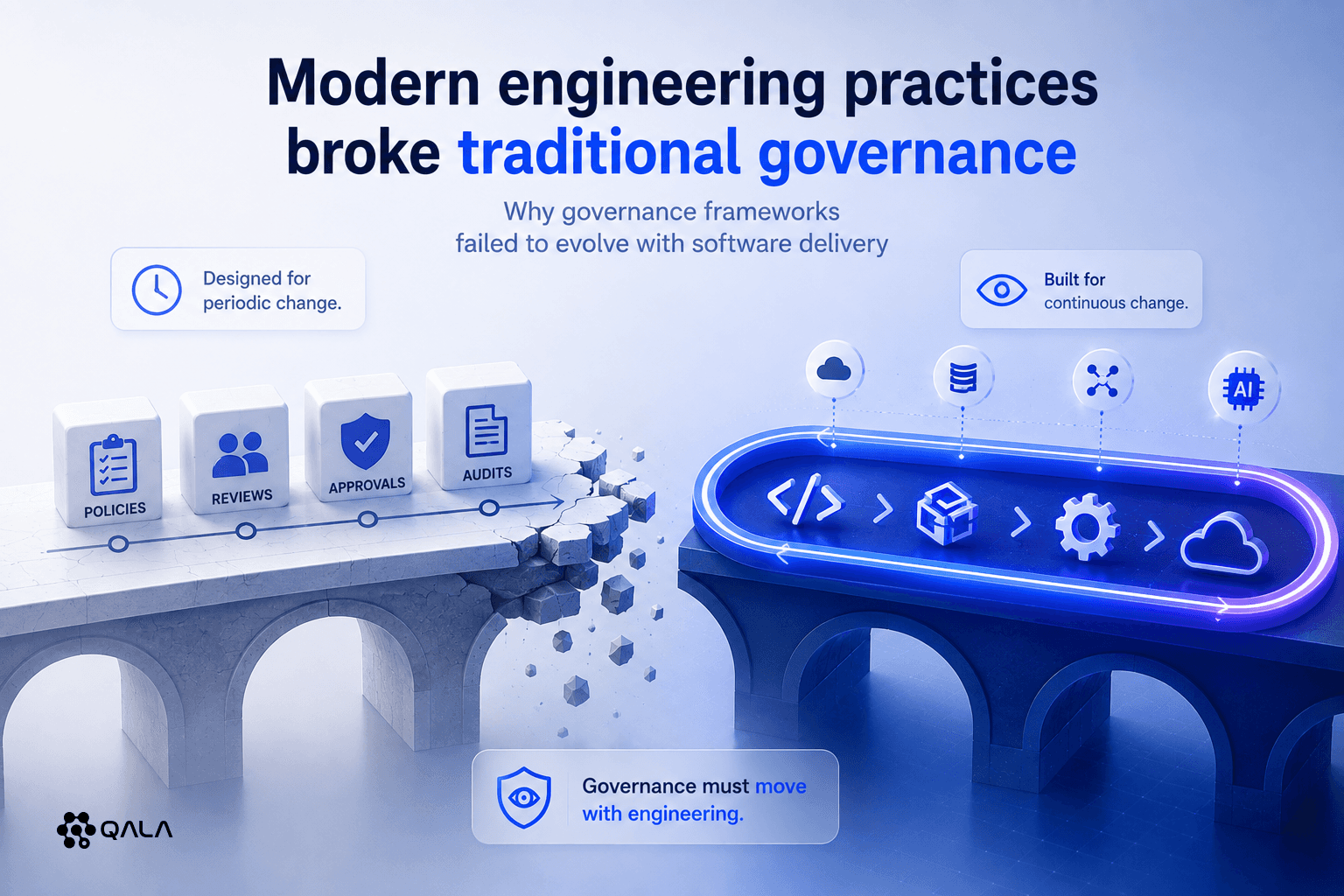
Why continuous visibility is becoming foundational to trust
Governance has traditionally relied on documentation - policies defined expectations. controls established safeguards and audits validated implementation - these mechanisms remain important but they increasingly answer only one question - "What should happen?".
Today, organisations need to answer a different one, "What is happening?"
That shift is redefining governance.
Trust now depends on visibility
Trust has always been central to governance. Either because we trusted that policies were followed, that controls remained effective or that sensitive information was always handled appropriately.
Historically, that trust was supported through periodic evidence but today, trust increasingly depends on continuous visibility.
Traceability changes governance
Traceability introduces something governance has traditionally lacked - operational certainty.
Rather than:
assuming how information moves, organisations can observe it,
documenting expected behaviour, they can verify actual behaviour,
reconstructing evidence after the event, they continuously generate it.
This fundamentally changes governance.
Traceability becomes the common language
One of the biggest challenges in governance is that different teams operate from different perspectives:
Engineering understands implementation.
Security understands threats.
Privacy understands regulation.
Compliance understands controls.
Leadership understands organisational risk.
Traceability connects them.
Everyone can observe the same operational reality and work from the same evidence.
AI makes traceability essential
AI is accelerating this transition.
Every new AI capability introduces additional operational paths, more services, more integrations and increase data movement.
Governance cannot rely on assumptions when systems behave dynamically - it requires continuous observation.
The governance platforms of the future
The next generation of governance platforms will not be built around document repositories nor will they focus primarily on workflow management or evidence collection.
They will become operational systems.
Continuously observing engineering environments, tracing sensitive data and verifying governance expectations.
Evidence will become a by-product of operational visibility.
The future belongs to organisations that can trace
The organisations best prepared for the next decade will not simply document governance more effectively, they will understand operational reality more completely.
Because governance begins with visibility, visibility begins with traceability and organisations cannot protect what they cannot trace.