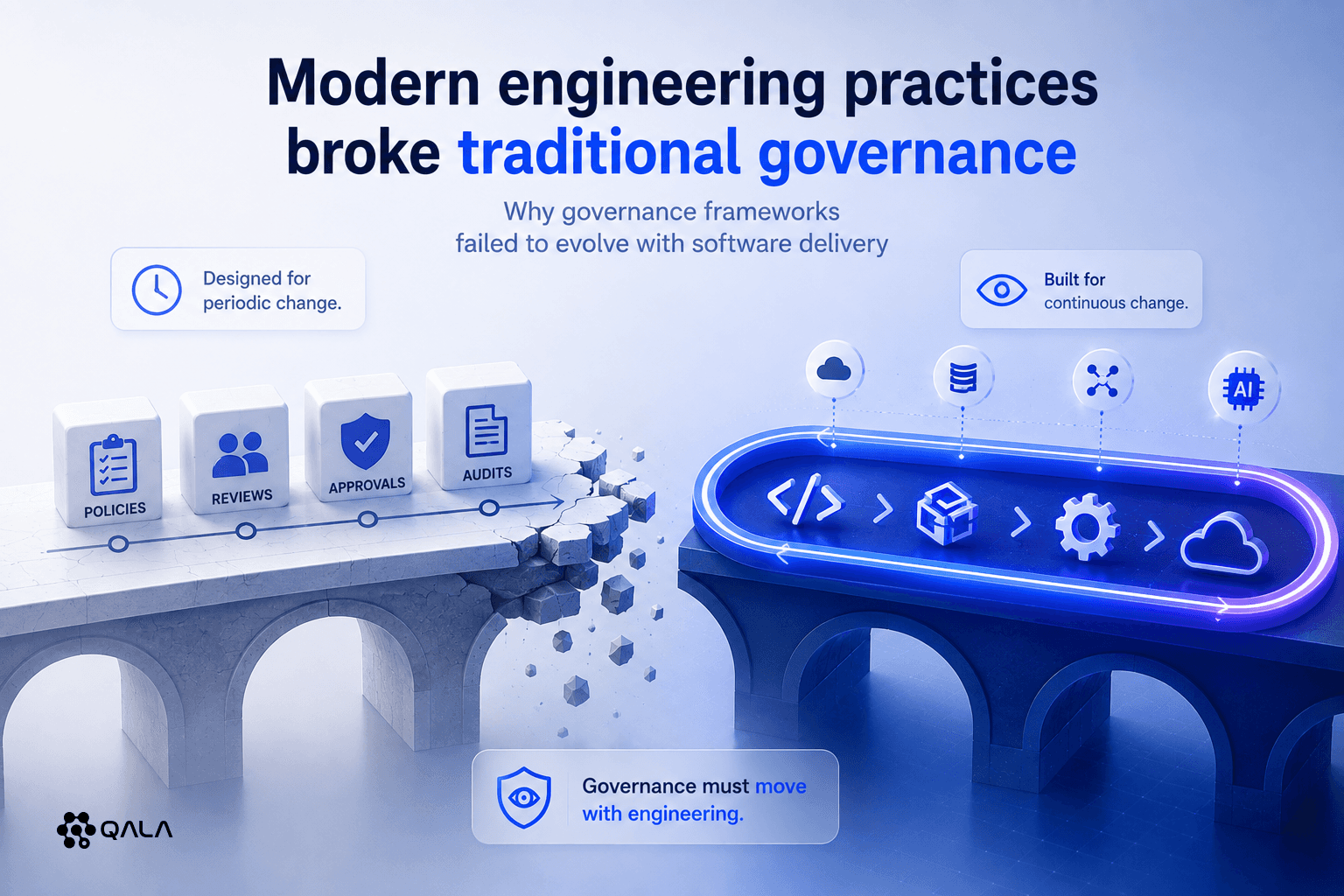
How cloud-native systems broke traditional visibility assumptions
Enterprise architectures were once relatively straightforward.
Applications communicated with predictable systems
Databases remained centralised
Infrastructure changed infrequently
Data followed well-understood paths
Governance reflected that simplicity
Today, almost every one of those assumptions has changed.
Cloud-native architectures have transformed how software is built, deployed and integrated. Microservices, APIs, SaaS platforms, third-party services and AI-enabled applications have created environments where data moves continuously across organisational boundaries.
The result is a new operational challenge.
Understanding where sensitive data is actually flowing has become significantly harder.
Distributed systems create distributed visibility
Most of engineering teams today optimise for flexibility - applications are decomposed into services, data is replicated, APIs connect internal and external platforms, cloud services scale dynamically - these architectural patterns deliver agility but they also fragment visibility.
No single system tells the complete story of how sensitive information moves.
Traditional governance assumed centralisation
Many governance models were designed around centralised environments and security teams knew where critical systems were located. Data repositories were relatively stable and changes occurred through structured release cycles, so visibility could be maintained through documentation and periodic reviews.
Distributed architectures make that approach increasingly unreliable - operational behaviour changes faster than governance can document it.
APIs become invisible governance boundaries
One of the biggest challenges introduced by distributed architectures is the growing importance of APIs. Every API represents another opportunity for sensitive information to move both internally and externally - between trusted environments or into entirely new services.
Yet governance programmes often have limited visibility into these operational pathways. Understanding where APIs exist is no longer enough.
Governance increasingly requires understanding what data actually moves through them.
AI introduces another layer of complexity
Artificial Intelligence compounds this challenge as AI systems consume information from multiple services simultaneously - data is enriched, transformed and routed dynamically.
Traditional architectural diagrams become outdated almost immediately.
Operational visibility becomes the only reliable source of truth.
Visibility must become continuous
The challenge is not documenting distributed architectures, it is continuously understanding them.
As engineering environments evolve, governance must evolve alongside them.
Visibility can no longer depend on periodic reviews, it must reflect operational behaviour as it happens.
Modern governance requires operational traceability
Distributed architectures are not reducing complexity, they are increasing it.
The organisations best positioned for the future will not attempt to simplify that complexity through documentation alone, they will continuously trace how sensitive data moves across their operational environment. Because governance depends on understanding reality, not assumptions.