Why your AI is only as good as your data
Over the past few weeks, the AI community has been captivted and alarmed by the parabolic rise of OpenClaw. For those not in the know, Open Claw is an open-source autonomous AI agent that runs locally on your machine, integrates with messaging platforms, and executes real-world actions on behalf of users. It’s been described as “AI that actually does things,” but what’s become equally clear is this:
If you allow powerful AI agents unfettered access to your data, systems, credentials with executable tooling you’re building risk into the very fabric of your businessprovided you can’t honestly see or control how that data is used.
What OpenClaw is and why it matters
OpenClaw (formerly Clawdbot and Moltbot – a branding mishap worthy of its own article) is a developer-friendly, open-source AI assistant designed to connect to apps like WhatsApp, Slack, iMessage, Telegram and Discord and then automate tasks. It can autonomously interact with APIs and even run system-level commands.
Its viral adoption stems from genuine utility, it’s playful, programmable, and autonomous. But that same autonomy has left major security researchers, national regulators, and enterprise security teams feeling somewhat uncomfortable. Why?
Instances are widely exposed on the public internet due to unsafe default network bindings and poor config hygiene. Thousands of them to be precise, accessible with little to no authentication.
Several critical vulnerabilities allowed remote code execution and credential exfiltration with minimal interaction. Literally via a crafted link.
OpenClaw’s “skills” ecosystem, which is designed to extend the agent’s capabilities, has been shown to contain hundreds of malicious modules that steal API keys, wallet private keys, browser credentials and more.
Open-source contributions and poor boundary enforcement mean supply-chain threats are present at scale.
This isn’t a niche hobbyist problem though. Automation that executes actions autonomously on behalf of users is rapidly creeping into environments where sensitive data and credentials live with the pressing need to be first to market.

The Deeper Risk Pattern
Here’s the uncomfortable truth that security teams are only just beginning to grapple with:
Traditional perimeter security and identity controls are blind to the behaviors of agentic AI that runs with legitimate permissions on endpoints.
Because OpenClaw agents:
run locally (bypassing enterprise deployment workflows),
execute code with escalated privileges,
and expose interfaces that are often misconfigured,
they fundamentally break the assumptions underlying firewalls, EDR, SIEM, CASBs and traditional data governance controls. A compromised AI agent doesn’t just leak data, it acts with authority to move it, manipulate it, and persist state over time.
This is a massive access and identity problem orchestrated by automation at scale.
What This Means for Risk and Compliance
In isolation, OpenClaw vulnerabilities are striking. But the systemic pattern they reveal is far more important:
- Sensitive data can leak before it’s ever logged
- Credential compromise can happen through legitimate-looking automation
- Misconfigurations expose high-privilege interfaces externally
- Autonomous agents act with authority that traditional controls can’t trace
This matters because risk is no longer defined by static repositories or controlled APIs, it’s defined by live data movement and interaction patterns occurring in real-time. And those movements often escape visibility until after something has gone wrong.

A Better Architecture for AI-Driven Enterprise
If we’re going to embrace AI that acts and automates — not just responds — then our foundations for visibility, compliance and control need to evolve.
This means:
Source-first data lineage — seeing data at creation, ingestion, and movement
Real-time classification and risk scoring, not periodic scanning
Policy enforcement before data leaves safe boundaries
Continuous observability into who/what is executing actions on data
The same gaps that made OpenClaw instances easy to expose and exploit are the gaps that make modern enterprises blind to AI-related risk.
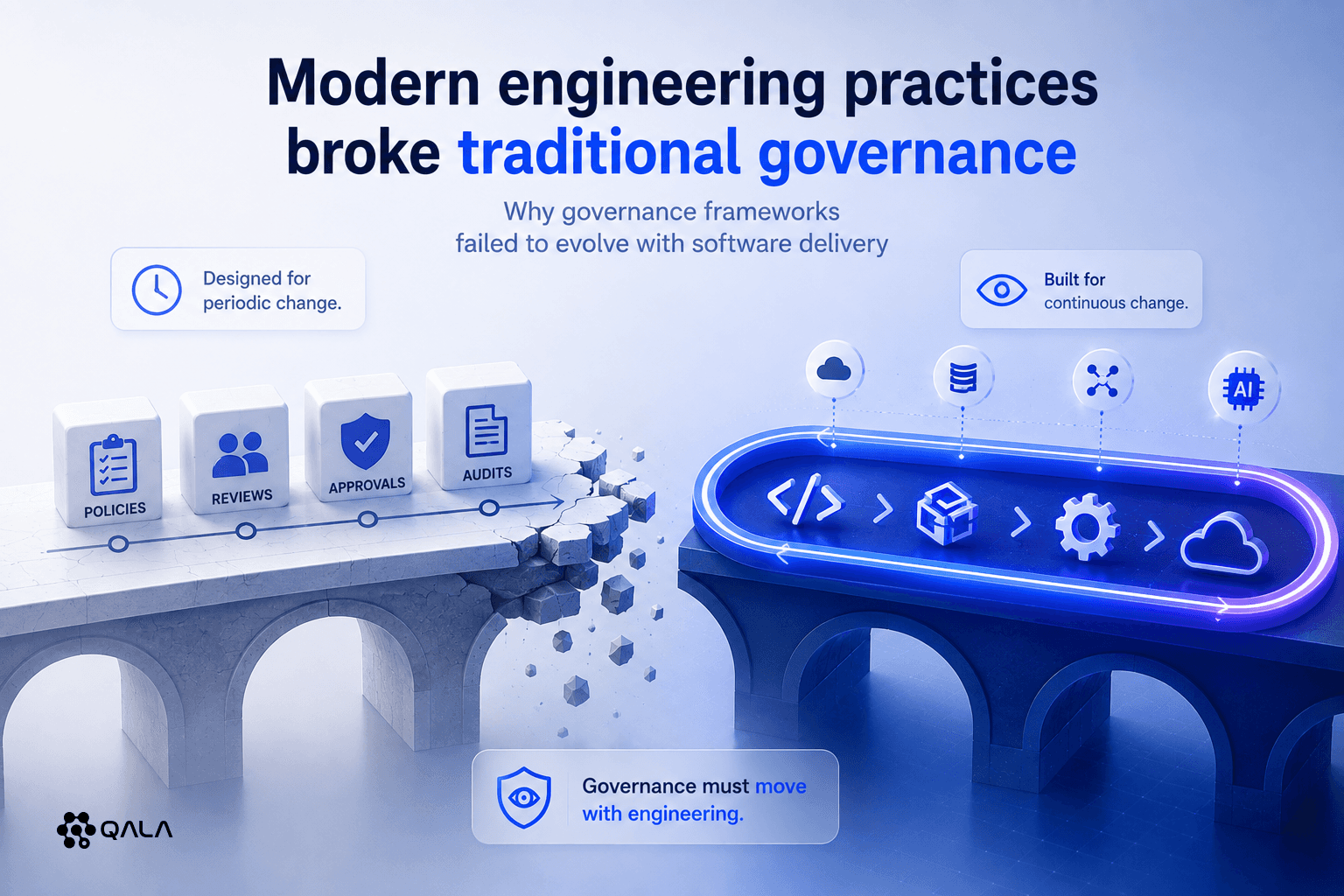
At Qala, we’re focused on precisely this gap. We are giving teams back confidence in their data flows and compliance posture by turning passive data into active governance and real-time enforcement. When governance only happens in audits or retrospectives, it’s already too late.
Key Takeaways
The real risk isn’t “rogue AI”; it’s weak data governance. Autonomous agents like OpenClaw become dangerous when they are given broad access to systems, credentials, and sensitive data without clear visibility or control.
Agentic AI breaks traditional security assumptions. Firewalls, EDR, SIEM, CASBs, and identity tools struggle when AI agents operate locally, use legitimate permissions, execute code, and move data in real time.
The compliance challenge is shifting from static data storage to live data movement. Risk now sits in how data is accessed, transformed, shared, and acted on by automation before anyone has a chance to audit it.
Enterprises need real-time governance, not retrospective control. Source-first lineage, continuous classification, policy enforcement, and observability must become foundational if businesses want to adopt AI safely.
Conclusion
The OpenClaw episode isn’t just a technology story it’s a tectonic shift in how automation challenges existing security models.
We’re entering a world where autonomous AI isn’t a fringe experiment but something your teams will adopt whether IT sanctions it or not. The question isn’t “if these risks matter” — it’s:
Do you have visibility into where data moves today, and control over where it shouldn’t?
If not, the next incident won’t be a news headline, it may well be your companies dead-line.