Why leading organisations are moving to operational monitoring
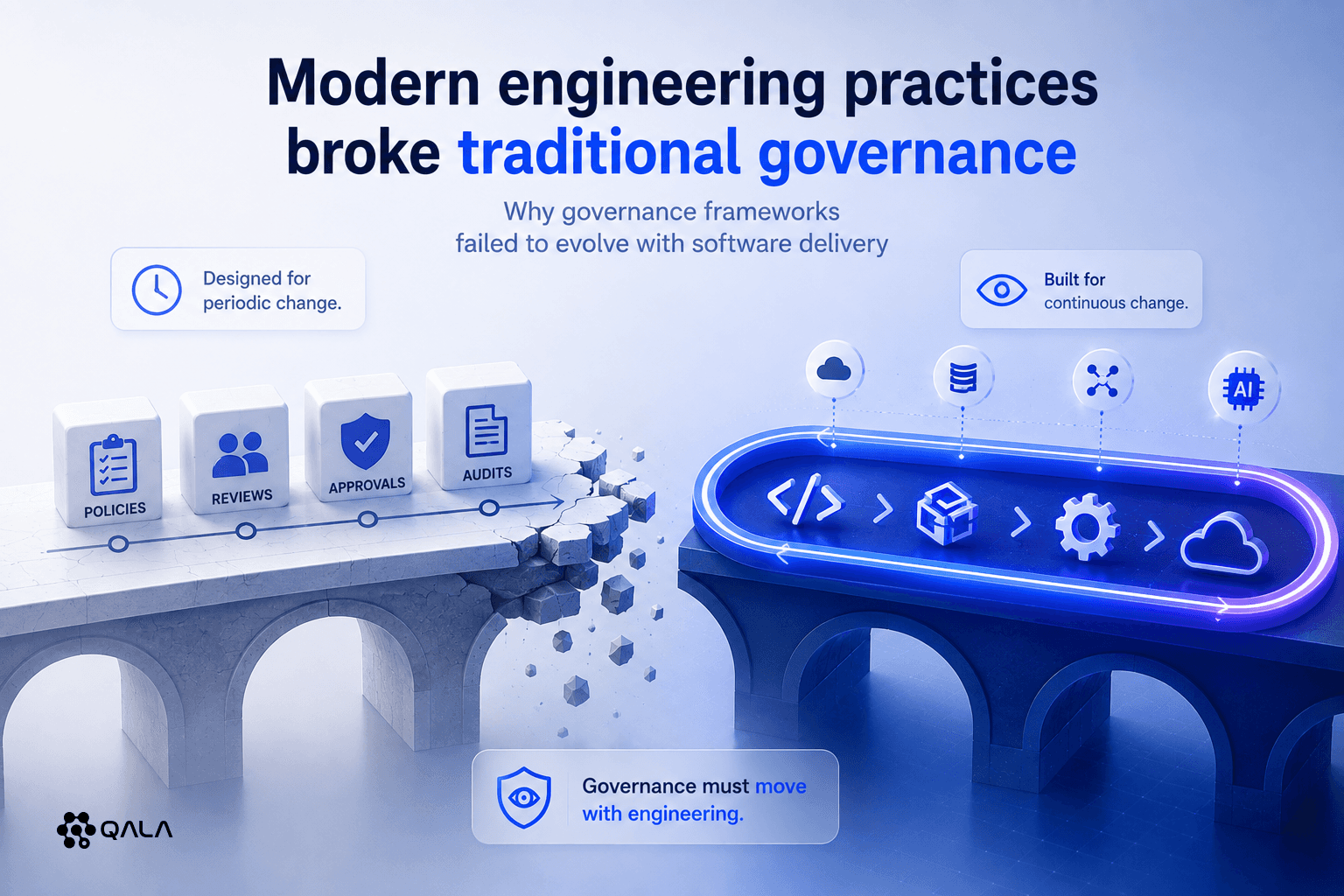
Governance is undergoing a fundamental transformation. For decades, security and governance leaders have relied on periodic reviews to validate risk, assess controls, and demonstrate compliance. Governance operated through scheduled checkpoints - quarterly reviews, annual audits, policy attestations, and manual evidence collection.
This model worked when technology environments changed slowly but modern environments no longer operate on predictable timelines. Cloud infrastructure changes daily, engineering teams deploy continuously, data moves across systems, third parties, and increasingly AI-enabled workflows - risk emerges in real time.
Yet many governance programmes still operate as if risk can be assessed periodically. This disconnect is becoming increasingly difficult to ignore.
The organisations best positioned for the future are responding by adopting a new model - continuous governance.
Governance was built around checkpoints
When looking at the traditional governance frameworks, we can notice they rely heavily on periodic validation. At specific intervals, teams review controls, assess risks, collect evidence, and confirm compliance requirements are being met - creating a governance model centred around checkpoints.
Between those checkpoints, governance visibility is often limited and this introduces a structural problem.
Operational environments continue changing, whether governance is actively observing them or not. New integrations appear, data flows evolve. access permissions change, AI systems introduce new operational behaviour and infrastructure shifts constantly.
Risk does not wait for governance reviews, rather develops continuously.
This means governance models built around fixed checkpoints increasingly struggle to reflect real operational reality.
Periodic reviews create blind spots
The problem with periodic governance is not necessarily the review itself, rather that lies in everything that happens between reviews - this is where modern governance blind spots emerge.
An audit may validate controls today, but those controls may drift tomorrow without any visibility. A review may confirm data handling aligns with policy, yet new workflows introduced next week may create entirely new exposure. Even a compliance assessment may indicate low risk at a point in time, while operational reality evolves significantly days later.
This creates a dangerous gap between governance assumptions and operational truth. The larger and more dynamic the companies become, the more significant that gap grows.
Security leaders are shifting towards operational monitoring
Leading organisations are recognising that governance can no longer function as a purely retrospective activity instead, governance is moving closer to operations.
Security leaders increasingly understand that effective governance requires continuous visibility into operational behaviour. This is driving a shift from periodic reviews towards operational monitoring.
The focus is changing from reviewing what happened to observing what is happening. This is a significant evolution in governance thinking.
Governance is no longer just about validating policies, frameworks, and controls - it is increasingly about continuously understanding how systems, data, and processes behave in practice.
Continuous governance changes the governance model
Continuous governance introduces a fundamentally different operating model, rather than relying solely on periodic evidence collection, organisations build the ability to observe operational signals continuously.
This includes visibility into:
Sensitive data movement
Access changes
Infrastructure changes
Third-party exposure
AI-driven workflows
Control drift
Policy deviations
This allows governance teams to detect risk as it emerges, not months later or during the next audit or assessment cycle. In real time.
This shifts governance from reactive to proactive.
Governance becomes more aligned with operational reality
One of the biggest benefits of continuous governance is alignment. Since traditional governance often operates separately from day-to-day operational activity, security teams, engineering teams, and governance teams may all work from different sources of truth.
Continuous governance reduces that disconnect by becoming grounded in operational reality rather than static documentation or assumptions. This creates stronger decision-making.
Security leaders gain better visibility into emerging risks, governance teams gain greater confidence in control effectiveness and leadership gains clearer understanding of exposure.
Most importantly, governance becomes capable of keeping pace with modern environments.
AI is accelerating this transition
The rise of AI is making this shift even more urgent and relevant as it introduces a new layer of complexity to governance.
Data moves through increasingly dynamic workflows, while models interact with sensitive information and the decision paths become more difficult to predict. Risk becomes harder to assess using traditional governance mechanisms.
This creates significant pressure on governance models built around periodic reviews. AI environments require greater visibility, faster detection, and more adaptive governance - in other words, they require continuous governance.
The more autonomous systems become, the more governance must evolve from static oversight to continuous observation.
The future of governance is continuous
Security leaders are reaching a clear conclusion - periodic governance alone is no longer sufficient.
That does not mean audits, assessments, or reviews disappear. These mechanisms still matter but they can no longer serve as the primary mechanism for governance.
The future of governance is continuous.
It is built on operational visibility, real-time monitoring, and continuous evidence. The companies best prepared for the future will not simply conduct more reviews, they will build stronger visibility.
Because modern governance is no longer about checking controls occasionally, it is about continuously understanding operational reality. And that shift is no longer optional.