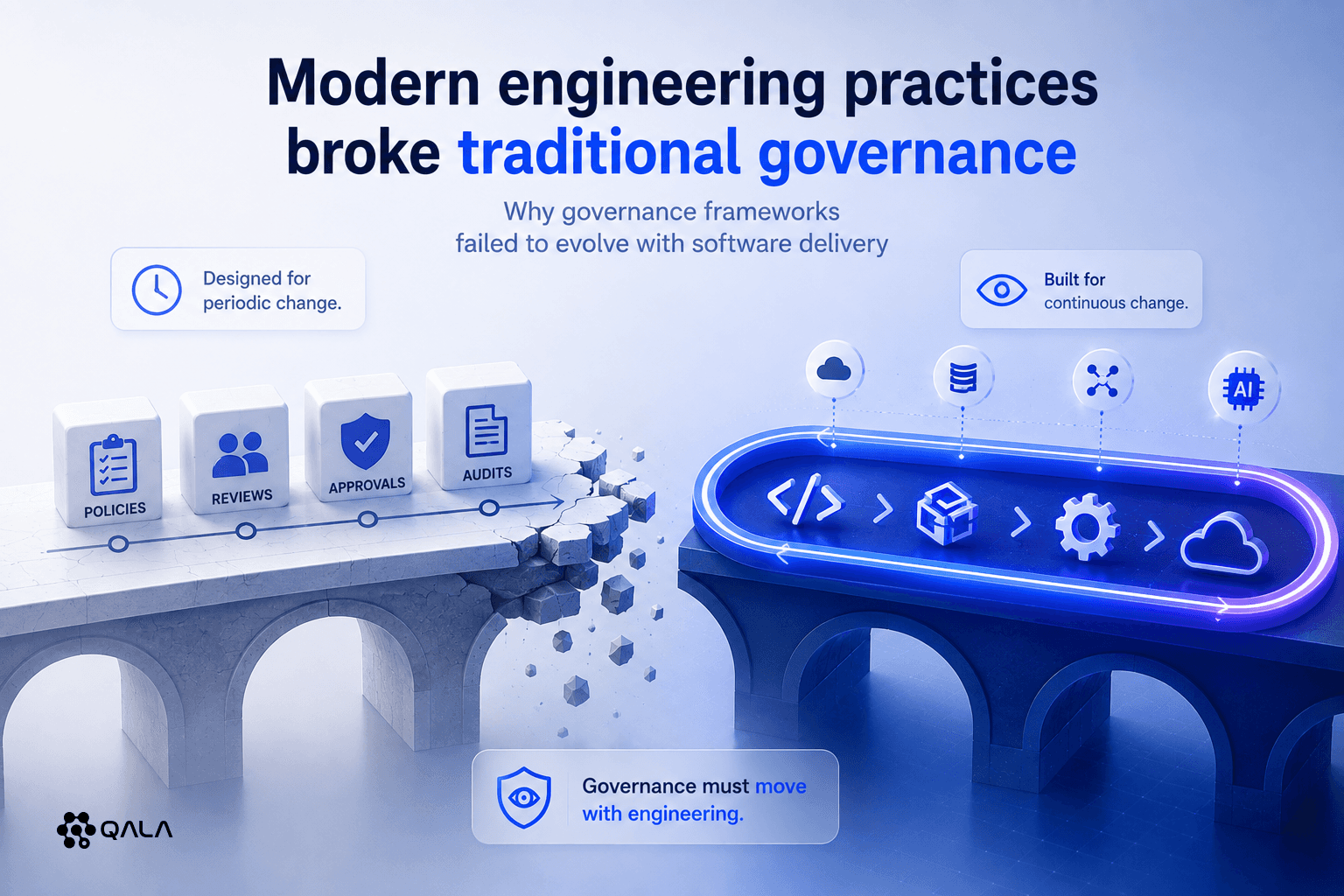
Why governance models must evolve beyond traditional boundaries
Enterprise security has historically been built around the perimeter focusing on protecting what exists inside, controling what enters and monitor what leaves.
This model reflected how organisations operated as most host application within their boundaries and centralise infrastructure. Data generally stayed inside organisational boundaries. Today, enterprises and their software landscape look very different.
The perimeter no longer defines risk
The same way cloud computing changed infrastructure, APIs changed integrations, SaaS changed application ownership, third parties changed operational models - AI is changing data movement.
All together, fundamentally changed where governance risk exists.
Sensitive information now moves continuously across environments that organisations neither own nor directly control.
Data no longer belongs to one system
One customer record may be processed by a CRM platform, an internal application, aeveral APIs and cloud servies, identity providers, customer engagement platforms, AI assistants or even analytics engines.
Governance cannot focus on individual systems, it needs to focus on the operational journey of the data itself.
Visibility gaps become governance gaps
Most organisations have significantly improved security and as a reflection, also strengthened governance.
The remaining challenge is visibility.
When governance teams cannot continuously observe how data moves, they cannot accurately understand where exposure exists.
Risk increasingly lives inside those visibility gaps.
Governance becomes ecosystem governance
Modern governance extends across organisational boundaries.
Internal systems;
External vendors;
Cloud platforms;
Partner ecosystems;
AI services.
The scope of governance has expanded dramatically and visibility must expand with it.
Continuous observation replaces boundary protection
This does not mean traditional security becomes irrelevant, there are essencial tools and applications – firewalls, identity, network controls, endpoint security – but governance increasingly depends on understanding operational behaviour rather than defending fixed boundaries.
The emphasis shifts from protecting locations to observing movement.
The future belongs to organisations that can see
The organisations best prepared for modern software environments will not simply strengthen the perimeter.
They will strengthen visibility because data risk no longer lives inside organisational boundaries - it lives wherever sensitive information moves.
And governance must be capable of following it.