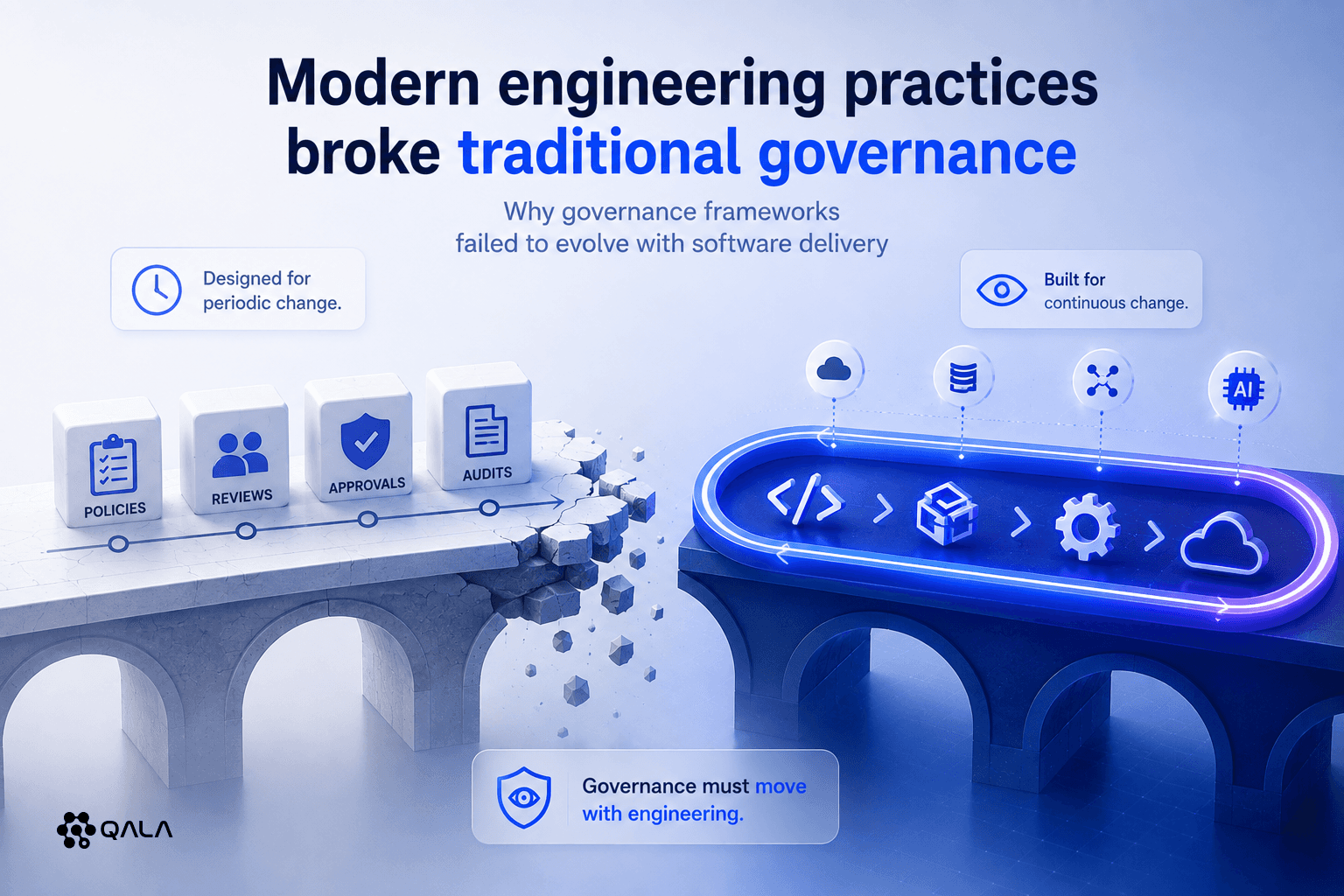
Why annual compliance cycles are incompatible with modern software
For decades, governance and compliance programmes have relied on a simple operating model. review controls periodically, collect evidence, validate compliance, produce reports, repeat next year.
This approach emerged in an era where technology environments changed slowly and governance operated comfortably behind the pace of operational change.
The challenge is that today, that world no longer exists. Software is deployed continuously and faster, infrastructure evolves daily, data flows change constantly and AI systems introduce new operational behaviours. Yet many governance programmes continue to operate on annual or quarterly review cycles.
The gap between governance processes and operational reality is becoming increasingly difficult to ignore and postpone.
The audit model was designed for stability
The reality is, traditional audit and compliance frameworks were never intended to govern highly dynamic environments. Instead, they were designed around periodic validation.
An auditor reviews evidence. A control owner provides documentation. Compliance is assessed at a specific point in time. The organisation receives assurance based on the information available during that review.
This worked reasonably well for all stakeholders involved, when systems remained largely unchanged between assessments. Today, however, significant changes can occur between Monday and Friday.
A quarterly review may already be outdated before the report is completed.
Software development and delivery changes everything
The rise of modern software engineering, technologies and tooling, fundamentally changed how organisations operate.
Development teams deploy continuously and faster, cloud resources scale automatically, third-party integrations are added rapidly, new APIs are introduced every week and AI capabilities are integrated directly into products and workflows.
The result is that operational environments evolve faster than governance processes can observe them, creating a situation where governance teams are often attempting to validate yesterday's reality while the business is already operating in tomorrow's environment.
The challenge is no longer collecting evidence, rather is ensuring evidence remains relevant.
Evidence has a shelf life
One of the least discussed challenges in governance is that evidence becomes stale remarkably quickly.
A screenshot captured during an audit represents a single moment.
A questionnaire reflects someone's understanding at a particular point in time.
An attestation confirms what an individual believes to be true when completing it.
None of these necessarily reflect current operational behaviour. As organisations and their teams accelerate software delivery and AI adoption, the useful lifespan of traditional evidence continues to shrink. Governance teams are therefore left with a growing problem - the faster the organisation moves, the less confidence they can place in historical evidence.
Continuous systems require continuous assurance
This does not mean audits will disappear, audits remain essential. The regulatory oversight and governance frameworks are essential. What changes is the source of assurance.
Rather than relying purely on periodic assessments, organisations increasingly require continuous evidence generated directly from operational systems. Evidence that reflects the reality today, not just the last quarter or year.
This shift mirrors other transformations already seen and quite relevant, when security evolved from annual penetration testing towards continuous monitoring or infrastructure evolving from manual reviews towards real-time observability.
Governance is beginning to follow the same path.
The future belongs to evidence-based governance
The most effective governance programmes of the future will not operate faster audits and will operate with better visibility. The goal won’t be about collecting more documentation, rather continuously validate operational behaviour.
Because governance ultimately exists to answer a simple question of trust on system based on operational intend and on current environments, the answer can no longer come from periodic reviews alone. It increasingly requires continuous evidence and continuous evidence requires continuous visibility.