Why governance failures increasingly happen in real time
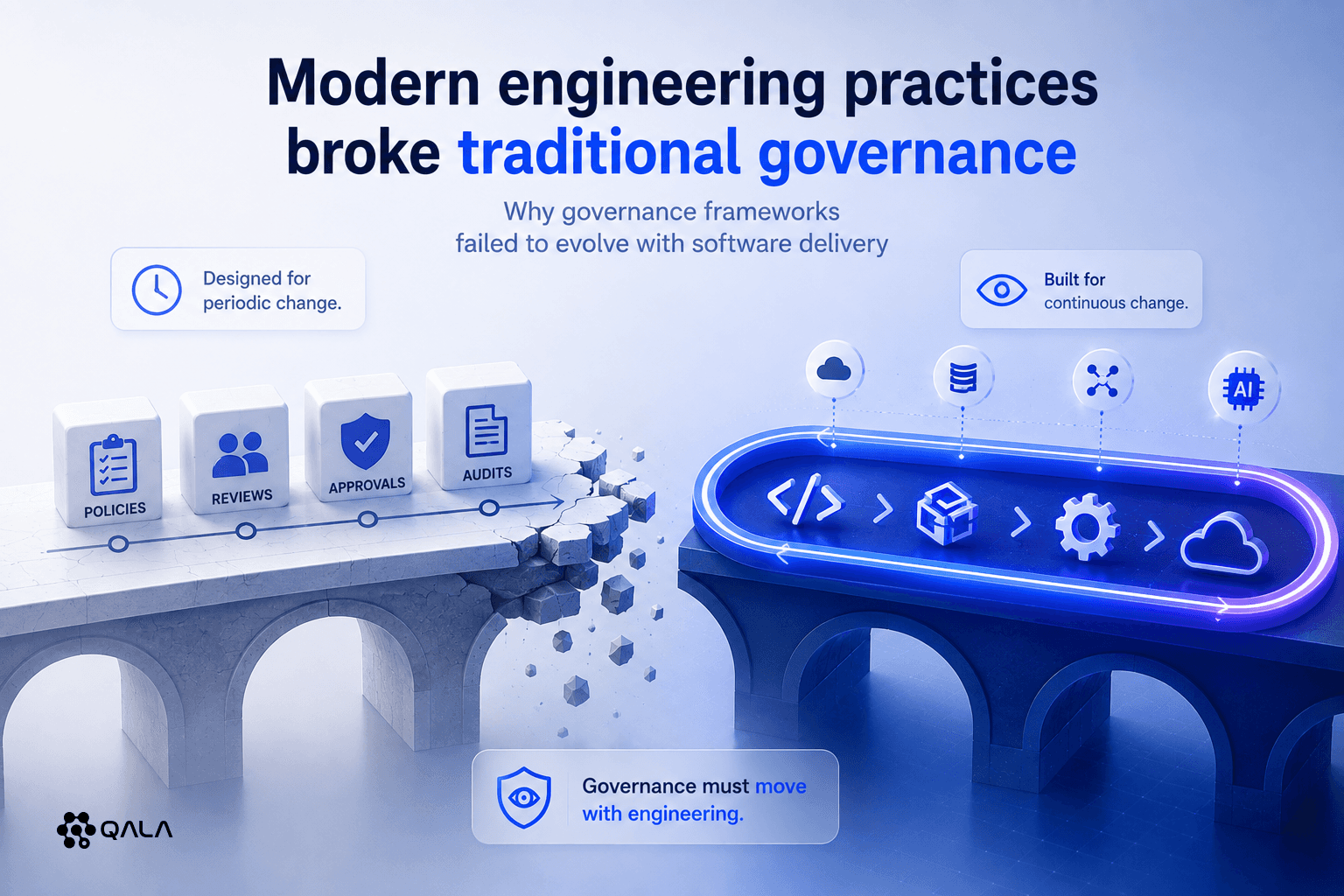
Most governance frameworks still operate around scheduled control reviews - monthly reviews, quarterly assessments and annual audits.
These mechanisms were designed to provide assurance that controls remain effective, policies are followed, and risk is managed appropriately.
Historically, this made sense. Operational environments changed slowly, infrastructure remained relatively stable, data flows were easier to understand and governance cycles could reasonably keep pace with business operations. That is no longer the case.
Today, data risk can emerge in minutes and in many organisations, governance mechanisms are still designed to detect issues months later.
This growing mismatch is creating one of the most important governance challenges of the modern era.
Risk no longer develops slowly
Traditional governance models were built around the assumption that risk accumulates gradually.
A process drifts over time.
A control weakens.
A configuration changes.
An audit eventually detects the issue.
Modern technology environments behave differently, risk now emerges dynamically.
Great examples of that, when a single cloud configuration change can expose sensitive data instantly or, a new API integration can create unexpected data flows. Today, an AI-enabled workflow can introduce entirely new handling behaviours overnight and also a vendor connection can expand data exposure without governance teams fully understanding the impact.
Risk is no longer something that slowly builds. Increasingly, risk appears in real time.
Data moves faster than governance can track
This challenge becomes even more significant when looking at data itself, as sensitive data rarely remains static.
It moves continuously across applications, cloud environments, vendors, partners, and AI systems. It is copied, transformed, enriched, shared, and processed across increasingly complex ecosystems.
Each movement creates potential governance implications and questions:
Who has access?
Where is the data going?
How is it being processed?
Is handling aligned with policy?
Has risk exposure increased?
The difficulty is that these changes often happen faster than governance teams can observe or even be aware. By the time a review takes place, operational reality may already look completely different.
This creates a dangerous visibility gap.
Governance failures increasingly happen between reviews
Many organisations still assume that if a recent audit showed compliance, risk remains under control. This assumption is becoming harder to defend even when happens for a checkbox exercise.
The reality is that governance failures increasingly occur between scheduled governance activities - not during the audit, reviews or assessments. Rather, between them.
This is where modern data risk lives.
The risk emerges in the periods where operational change continues but governance visibility stops. Creating critical weakness in traditional governance models.
They provide periodic visibility into continuously changing environments - this is no longer sufficient.
The problem is not controls. It is visibility.
Most organisations already have policies, governance frameworks, and controls. That is not usually the problem.
The bigger challenge is visibility into operational behaviour, governance teams often know what should happen.
They have policies that define how sensitive data should be handled. Standards that define expected controls and frameworks that establish governance processes. Yet, understanding what should happen is not the same as understanding what is happening.
That distinction matters.
Because governance failures rarely happen because organisations lack intent, they happen because operational reality changes faster than governance can observe.
Governance must move closer to runtime
The future of governance requires a fundamental shift where governance no longer operate primarily as a retrospective function - it must move closer to runtime.
This means developing the ability to observe operational behaviour continuously, rather than relying solely on periodic checkpoints.
Governance teams increasingly need visibility into:
Real-time data movement
Access changes
Third-party data exposure
Cloud configuration changes
AI-driven workflows
Operational drift from policy
This level of visibility allows organisations to identify risk as it emerges rather than long after exposure occurs. Changing governance from reactive to proactive.
The future of governance is continuous visibility
Leading organisations are already moving in this direction, most are even brining compliance closer to their cyber and security teams.
They are shifting away from governance built around static evidence and scheduled reviews. Instead, they are building governance capabilities around continuous operational visibility.
This allows them to understand risk in real time - not weeks or months later or even during audit cycles. They are seeing it now.
This shift is becoming increasingly critical in AI-driven environments, where operational complexity is accelerating even further. The organisations best positioned for the future will not necessarily have more controls - they will have better visibility.
Because modern governance is no longer about reviewing what happened, it is about understanding what is happening. Continuously.