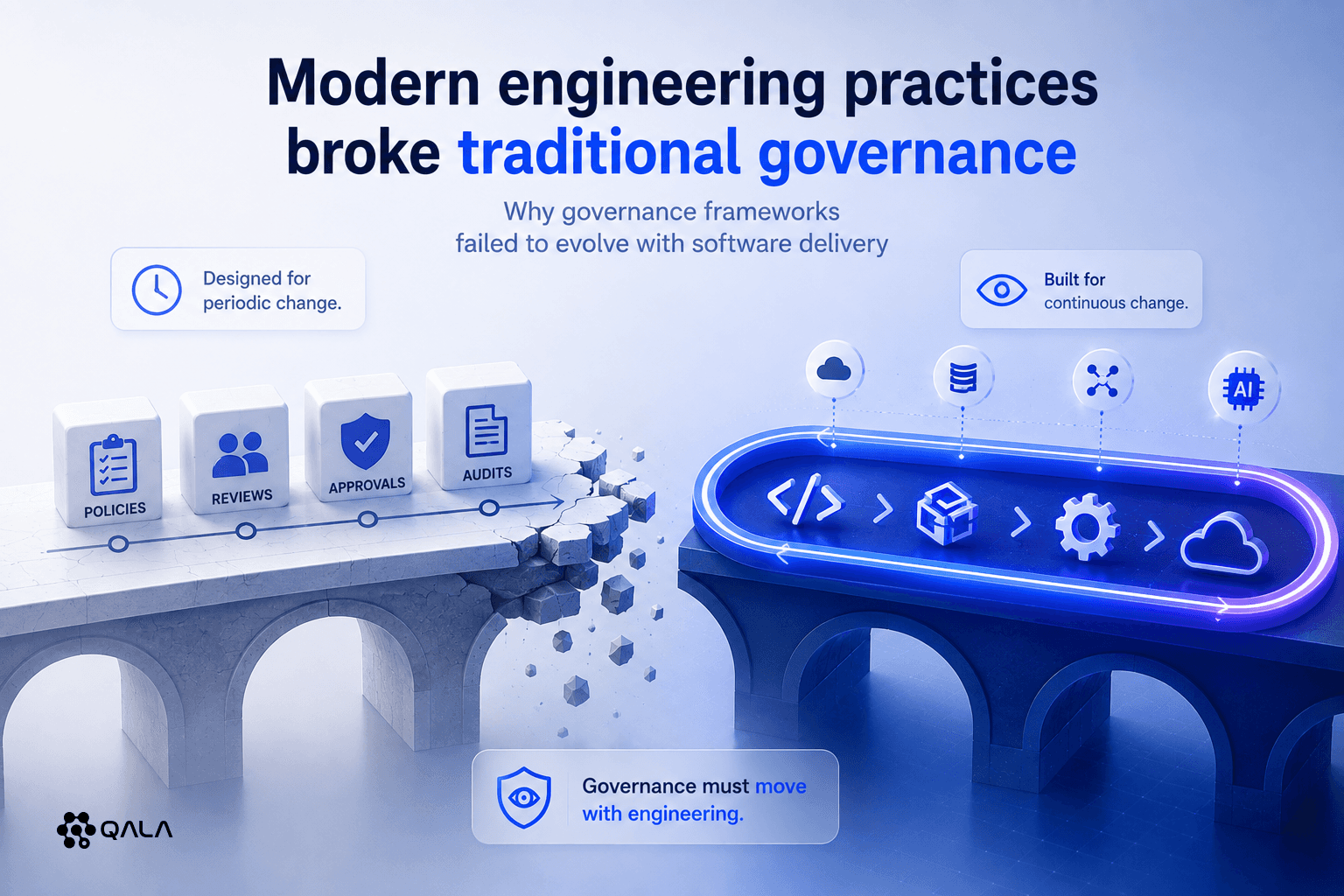
How environments gradually diverge from approved governance models
Security failures are often imagined as sudden events - a breach, a misconfiguration. a compromised account or an exposed database.
In reality, many governance failures develop much more quietly as they emerge gradually.
Small operational changes accumulate over weeks and months until the environment no longer resembles the one governance originally approved - this phenomenon is becoming increasingly common and it is known as security drift.
Drift rarely starts with a mistake
Most environments do not become insecure overnight, they evolve with cloud configuration changes, new integrations added, applications updated, permissions expanded, infrastructure scaled or new AI capabilities introduced.
Each individual change appears reasonable but collectively, they alter the security posture of the environment.
Governance often remains unchanged
Although operational environments evolve continuously, governance documentation rarely evolves at the same pace. Policies remain current, control descriptions remain unchanged, audit evidence continues to reflect historical validation - meanwhile, operational behaviour slowly diverges from governance expectations.
Nobody notices because every individual change appears insignificant.
Drift creates invisible risk
The danger of security drift is not the change itself, rather the growing gap between documented governance and operational reality.
Organisations believe approved controls remain effective but in practice, those controls may no longer operate exactly as intended:
Access expands beyond original expectations.
Data flows through additional systems.
Third parties become increasingly connected.
AI-enabled processes introduce entirely new operational paths.
None of these developments may immediately trigger an incident although they quietly increase exposure.
Annual reviews cannot detect continuous change
Traditional governance relies on scheduled validation. reviews, audits and assessments. These provide valuable assurance at a specific moment.
Security drift happens between those moments.
By the time governance reviews the environment again, operational behaviour may already have changed significantly.
The issue is not poor governance, it is insufficient visibility.
Visibility limits drift
Leading organisations increasingly recognise that drift cannot be prevented through documentation alone, it must be observed.
Continuous operational visibility allows governance teams to understand how environments evolve over time. Rather than identifying drift months later, they detect changes as they occur.
This fundamentally changes governance. It becomes proactive rather than retrospective.
Drift is becoming inevitable
As environments become increasingly dynamic, some degree of drift becomes unavoidable.
The objective is no longer preventive, it becomes about ensuring governance evolves alongside operational reality. The organisations best positioned for the future will not assume approved controls remain effective indefinitely, they will continuously verify them. Because the biggest governance failures are often the ones that happen gradually.