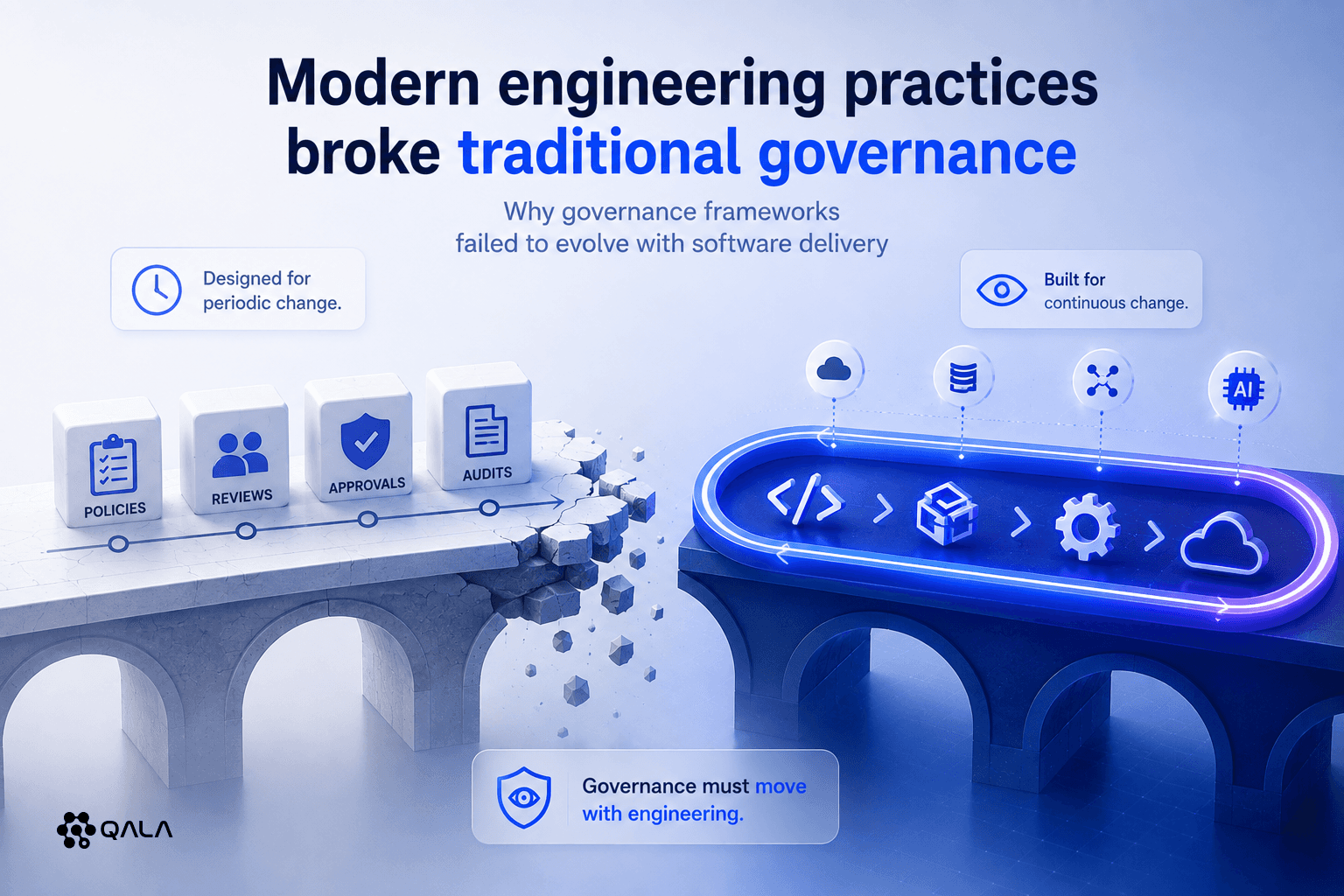
Why documented controls often diverge from operational systems
Governance has always been built around intent - policies define how information should be handled, standards specify how systems should be configured, control frameworks describe the safeguards organisations expect to have in place and audit evidence demonstrates that those controls were implemented at a particular point in time.
For many years, this approach provided reasonable assurance.
Today, it increasingly provides confidence without certainty as technology environments change continuously. Applications evolve daily, cloud infrastructure is updated automatically, integrations appear without governance teams being involved, and AI-enabled workflows introduce entirely new ways for data to move.
The challenge is no longer defining governance, it is knowing whether governance still reflects operational reality.
Intent is where governance begins
Every governance programme starts with the same objective - to define how an organisation expects systems, people and data to behave.
Policies establish acceptable practices
Standards define technical requirements
Controls translate governance objectives into operational safeguards
These remain essential as without documented intent, governance has no direction.
The difficulty begins once those controls enter production.
Production rarely stands still
Once systems become operational, they begin changing immediately with:
Development teams release new features.
Cloud services evolve.
Third-party vendors introduce new capabilities.
Access permissions change.
New integrations appear.
Business requirements shift.
None of these changes necessarily violate governance but together they create an environment that rarely looks identical to the one originally approved.
Operational reality moves continuously. Documentation usually does not.
Governance assumes consistency
Governance often assumes that once controls have been validated, they continue operating as expected. This assumption made sense when operational change happened gradually.
Today, environments evolve too quickly for periodic validation to maintain confidence. A control that aligned perfectly with governance expectations six months ago may now operate very differently.
Not because anyone intentionally bypassed governance. Simply because the environment evolved.
Runtime tells a different story
One of the biggest challenges governance teams face today is that documented controls describe design.
Runtime behaviour reveals reality and a great of example of this is when a policy may require encryption, runtime determines whether sensitive data remains encrypted throughout every operational workflow, a standard may require restricted access and runtime shows who actually accessed sensitive information. Or also when a governance framework may prohibit external data sharing and runtime demonstrates whether data has moved beyond organisational boundaries.
Governance increasingly depends on observing operational behaviour rather than assuming it.
Documentation cannot observe behaviour
This is not a criticism of governance documentation - policies, standards and procedures remain essential. But they were never designed to observe operational systems continuously.
Documentation explains what should happen. Runtime demonstrates what is happening.
That distinction is becoming increasingly important as organisations operate across cloud platforms, APIs, third-party services and AI-enabled environments.
Governance moves closer to operations
Leading organisations and vendors are beginning to rethink governance.
Rather than treating governance as a periodic validation exercise, they are bringing governance closer to runtime. Continuous operational visibility allows governance teams to understand whether controls continue behaving as intended despite continuous change.
This strengthens confidence, not because documentation becomes less important but because intent is continuously validated against operational reality.
The future belongs to organisations that verify
Governance intent will always matter as it defines expectations. Operational reality determines whether those expectations continue to be met.
The organisations best prepared for increasingly dynamic environments will not rely solely on documented controls, they will continuously verify that governance remains true where it matters most. In production.