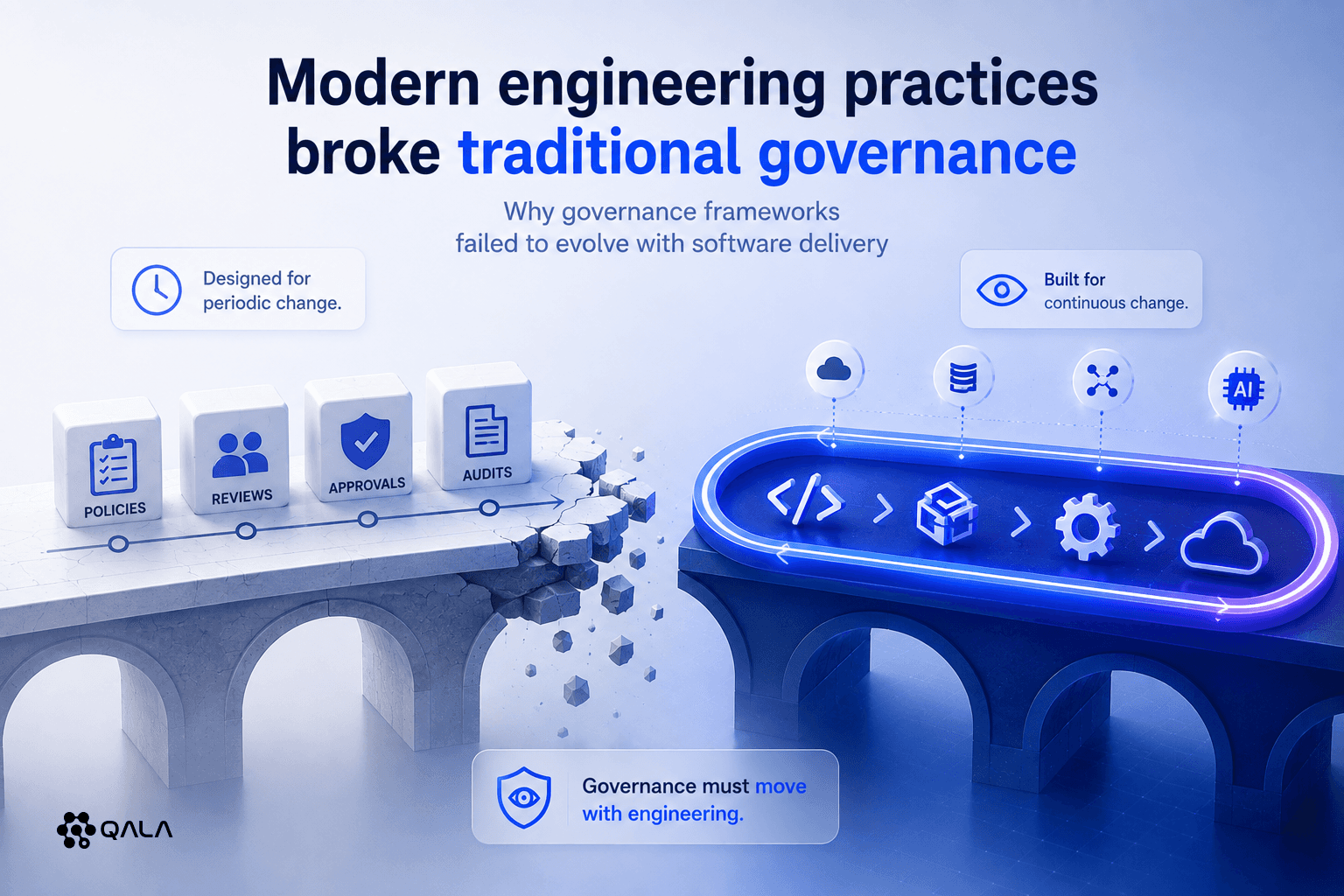
How AI agents, copilots and orchestration layers changed risk surfaces
Artificial Intelligence is not simply another application, overtime it will change how software behave.
AI systems increasingly interact with multiple data sources, external services, internal applications and autonomous workflows simultaneously. This creates governance challenges that traditional control models were never designed to address.
The issue is not simply that AI introduces new technology, for the governance teams, it introduces entirely new blind spots.
AI changes where decisions happen
Historically, operational decisions followed relatively predictable software logic where applications executed predefined business rules, users initiated workflows and integrations remained largely deterministic.
AI is changing this model as responses become contextual, workflows become by definition adaptive and agents orchestrate actions across multiple systems.
Information is processed dynamically and operational behaviour becomes significantly harder to predict using traditional governance approaches.
Every AI interaction creates another governance question
Each AI-enabled workflow is introducing important governance considerations.
Which systems supplied the information?
Which data sources were accessed?
Which third parties became involved?
Which policies apply?
How was sensitive information processed?
Governance documentation rarely answers these questions continuously and this is why operational visibility becomes essential.
AI introduces invisible operational paths
As we read every day, one of the biggest challenges with AI is that many operational paths never previously existed from the simple use cases to the more complex ones:
A copilot summarises internal documents;
An AI assistant queries multiple systems simultaneously;
An orchestration layer invokes several APIs;
An autonomous agent performs actions across multiple applications.
Each interaction creates additional movement of enterprise information and many or even most organisations remain unaware of these operational pathways.
Blind spots increase as AI adoption grows
The challenge is not simply AI it is about the growth of complexity, every new model, prompt, integration and agent introduces additional operational behaviour.
Governance teams cannot manage this complexity through documentation alone.
Visibility becomes the control
AI governance increasingly depends on understanding operational behaviour rather than documented intent.
Security leaders require visibility into:
AI-enabled data movement;
Third-party AI services;
Autonomous workflows;
Dynamic integrations;
Runtime behaviour.
These become the new governance controls.
AI governance becomes operational
The future of AI governance will not depend primarily on approval processes, it will depend on continuous observation. We cannot govern AI systems they cannot see operating.