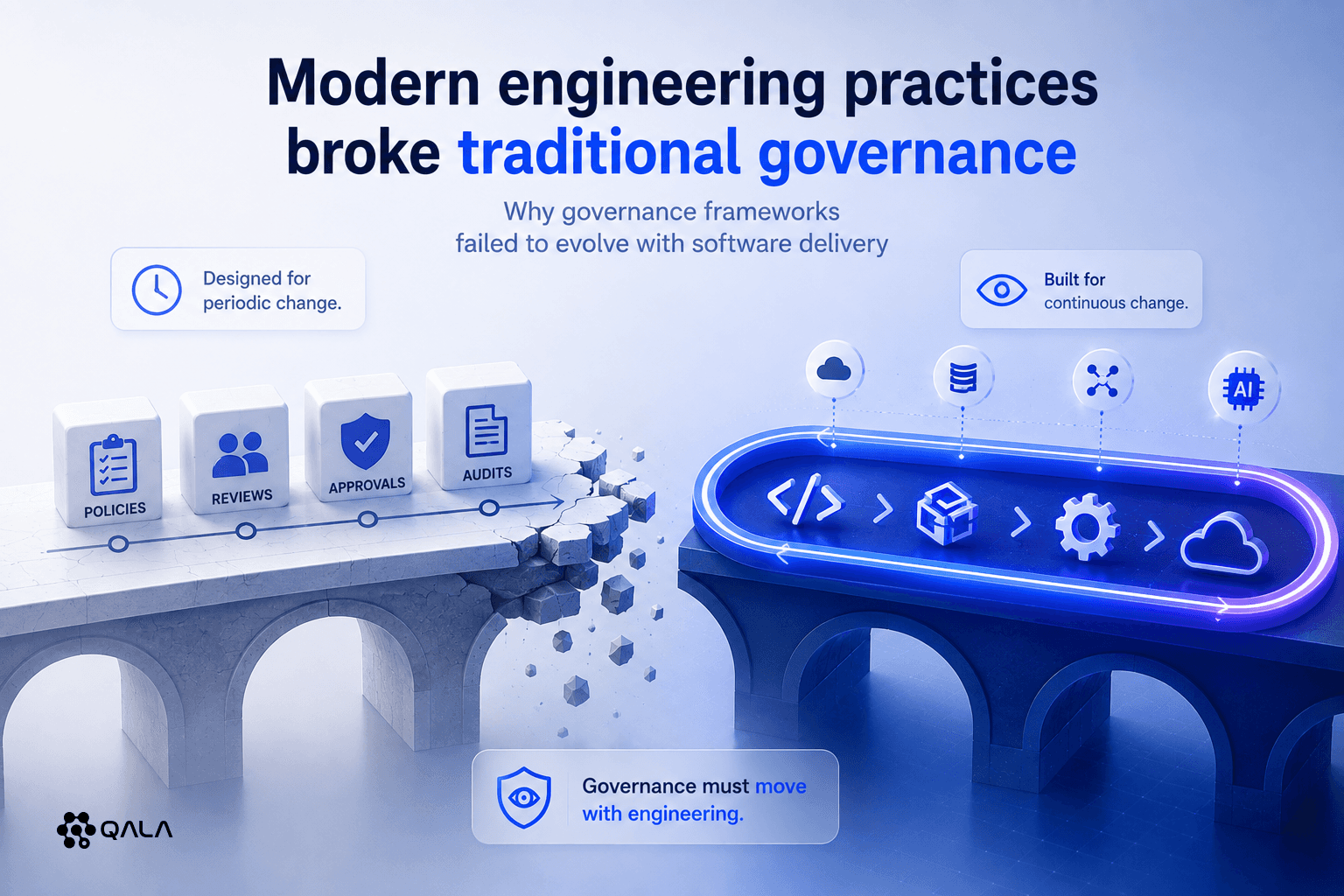
The next Generation of Governance will be operational, not procedural
For years, governance was treated primarily as a compliance function.
Policies were written.
Controls were mapped.
Audits were performed.
Evidence was collected periodically.
And for a long time, this model was largely sufficient.
But modern organisations no longer operate in environments where governance can remain static.
Engineering velocity accelerated.
Infrastructure became distributed.
Data flows became dynamic.
AI introduced autonomous operational behaviour.
Third-party dependencies multiplied.
The result is that governance is no longer simply a policy challenge. It is now an operational challenge. This changes the role leadership must play.
The organisations adapting most effectively are not necessarily those creating the most policies.
They are the organizations redesigning governance as a continuous operational capability embedded directly into modern engineering environments.
This requires a fundamental shift in mindset.
Governance can no longer operate separately from engineering reality
Historically, leadership and governance teams operated through abstraction:
frameworks,
attestations,
architecture reviews,
periodic assessments.
But modern systems evolve too quickly for governance to rely only on retrospective processes.
Leadership teams increasingly need operational answers in near real time:
Where is sensitive data moving?
Which controls are actually effective?
Where does policy drift emerge?
How are AI systems interacting with enterprise data?
Which third parties create operational exposure?
How does engineering behaviour impact governance posture continuously?
These are no longer theoretical governance questions.
They are operational risk questions.
And operational questions require operational visibility.
The future is continuous governance
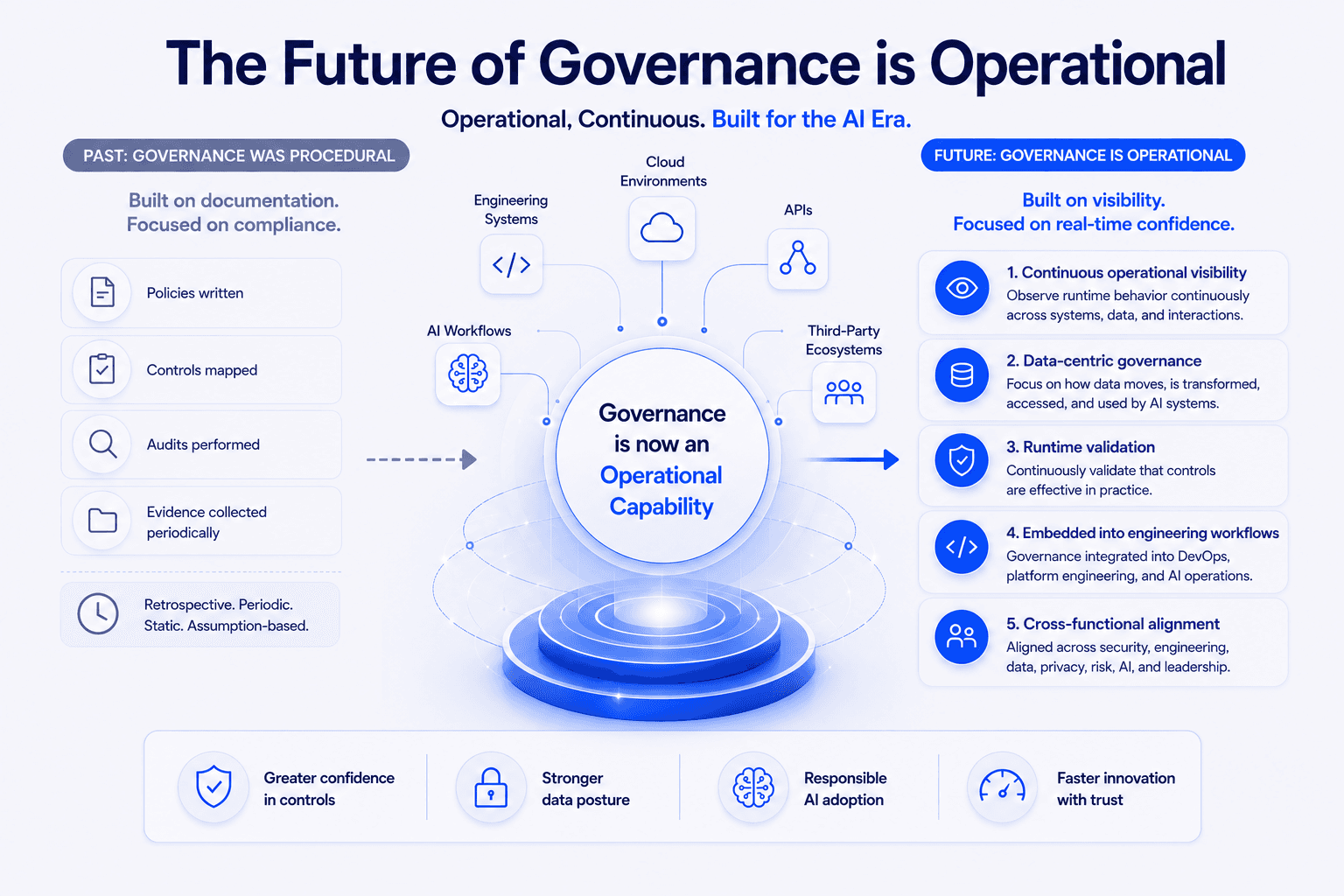
The next generation of governance will likely evolve around five foundational capabilities:
1. Continuous operational visibility
Organisations need the ability to continuously observe runtime behaviour across engineering systems, APIs, AI workflows, cloud environments, and third-party ecosystems.
Not periodically.
Continuously.
2. Data-centric governance
Traditional governance focused heavily on systems and infrastructure.
Modern governance increasingly focuses on data itself:
where it moves,
how it is transformed,
who accesses it,
and how it interacts with AI systems.
3. Runtime validation over static assumptions
Controls documented on paper are no longer sufficient.
Organisations need continuous evidence that controls remain effective operationally as systems evolve.
4. Governance embedded into engineering workflows
Governance cannot remain isolated from product engineering, DevOps, platform engineering, and AI operations.
The most mature organisations increasingly integrate governance directly into development and operational processes.
5. Cross-functional leadership alignment
The future of governance is not owned solely by compliance teams.
It increasingly requires alignment across:
CISOs,
CIOs,
engineering leadership,
data governance,
privacy,
risk,
and AI leadership functions.
Because modern operational risk now spans all of them simultaneously.
This is not about slowing innovation down
One of the biggest misconceptions around governance modernisation is that stronger governance reduces agility. In reality, the opposite is increasingly true.
Organisations with continuous visibility and operational assurance can move faster because they operate with greater confidence.
Confidence in:
their controls,
their data posture,
their AI adoption,
and their operational resilience.
The goal is not more friction.
It is more trustworthy innovation.
The leadership challenge ahead
The AI era is exposing the limitations of governance models built for slower and more centralized environments.
This does not mean governance becomes less important.
It means governance becomes more operational.
The organisations that adapt successfully will likely be those that evolve governance from:
retrospective → continuous,
procedural → operational,
static → adaptive,
assumption-based → evidence-based.
Because in modern environments, trust increasingly depends on the ability to continuously validate operational reality.
And operational visibility is rapidly becoming foundational to that future.