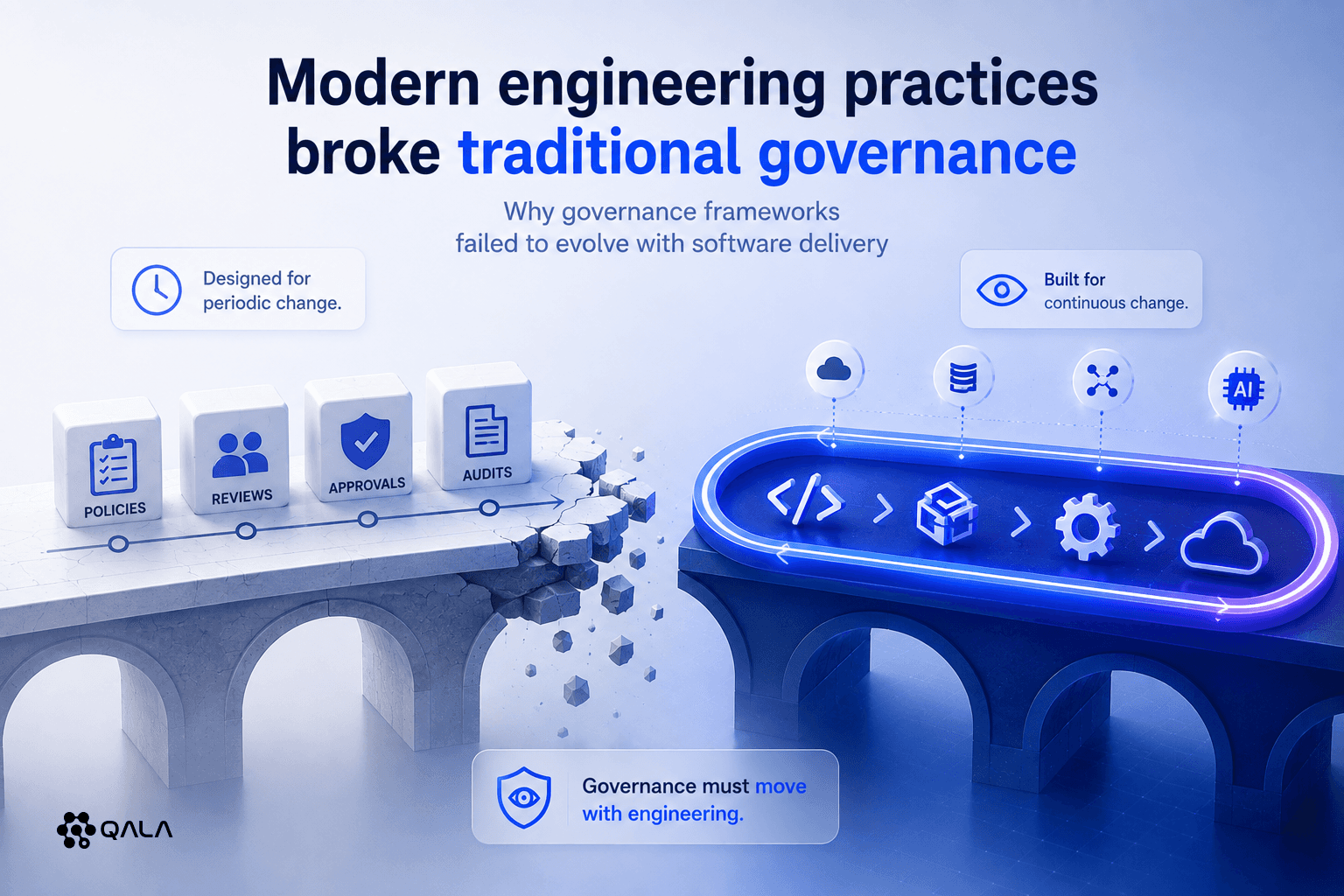
Why governance is shifting from declarations to provable evidence.
Governance has traditionally been built on trust - that policies are followed, controls operate correctly, teams comply with established processes and that evidence accurately reflects reality.
For many years, this model was sufficient. Maybe because organisations and teams were smaller. Technology environments were simpler and not so well connected. Operational change occurred at a manageable pace. Today, however, trust alone is becoming increasingly difficult to sustain, not because organisations have become less responsible, more because operational complexity has grown beyond what trust-based governance can reliably manage.
Complexity changes everything
Most organisations, regardless of their size, operate within ecosystems that are vastly more interconnected than ever before. Data flows across cloud platforms and entities, applications connect through APIs, third parties process critical information, AI systems interact with enterprise data and engineering teams deploy continuously.
The number of decisions, interactions, and operational changes occurring every day has increased exponentially.
As complexity increases, visibility decreases. And as visibility decreases, trust becomes increasingly dependent on assumptions.
Governance built on assumptions creates risk
Many governance programmes continue to operate using indirect indicators. Reviewing policies, ask teams to complete questionnaires, map control and collect any evidence manually. All these activities create confidence, but confidence is not the same as certainty.
A governance framework may indicate that a control exists yet, does not necessarily prove that the control remains effective. Same way a policy may describe how data should be handled but it doesn’t prove how data is actually handled. Or an attestation may confirm compliance although does not verify operational behaviour.
Why is this distinction becoming increasingly important? Organisations are now expected to govern environments they can no longer fully observe through traditional processes.
The shift from declarations to verification
Across multiple disciplines, organisations are moving away from declarations and towards verification. Great examples of that are the - security teams that are teams increasingly validate rather than assume – the Engineering teams that are increasingly observe rather than infer – and the Infrastructure teams that increasingly measure rather than estimate.
Governance is beginning to experience the same transition. Where the questions move from are the controls documented to can controls be verified? And can we demonstrate the policy is reflected in operational behaviour?
This represents a fundamental shift in governance thinking.
Verifiable governance
Verifiable governance is built on a simple principle - trust should be supported by evidence, not occasional evidence. Rather, continuous evidence.
It requires the development of the ability to observe operational behaviour directly rather than relying exclusively on documentation, attestations, and retrospective reviews.
Strengthening the trust that becomes grounded in observable reality rather than assumptions.
The future of governance
The organisations best positioned for the future will not necessarily have more policies, rather they will have greater visibility. There will focus on validation of controls instead of documentation and not rely solely on declarations but on evidence.
The AI era is accelerating this transition. As systems become more autonomous, interconnected, and dynamic, governance must become more observable, more operational, and more verifiable.
Trust remains important, but trust alone is no longer enough.