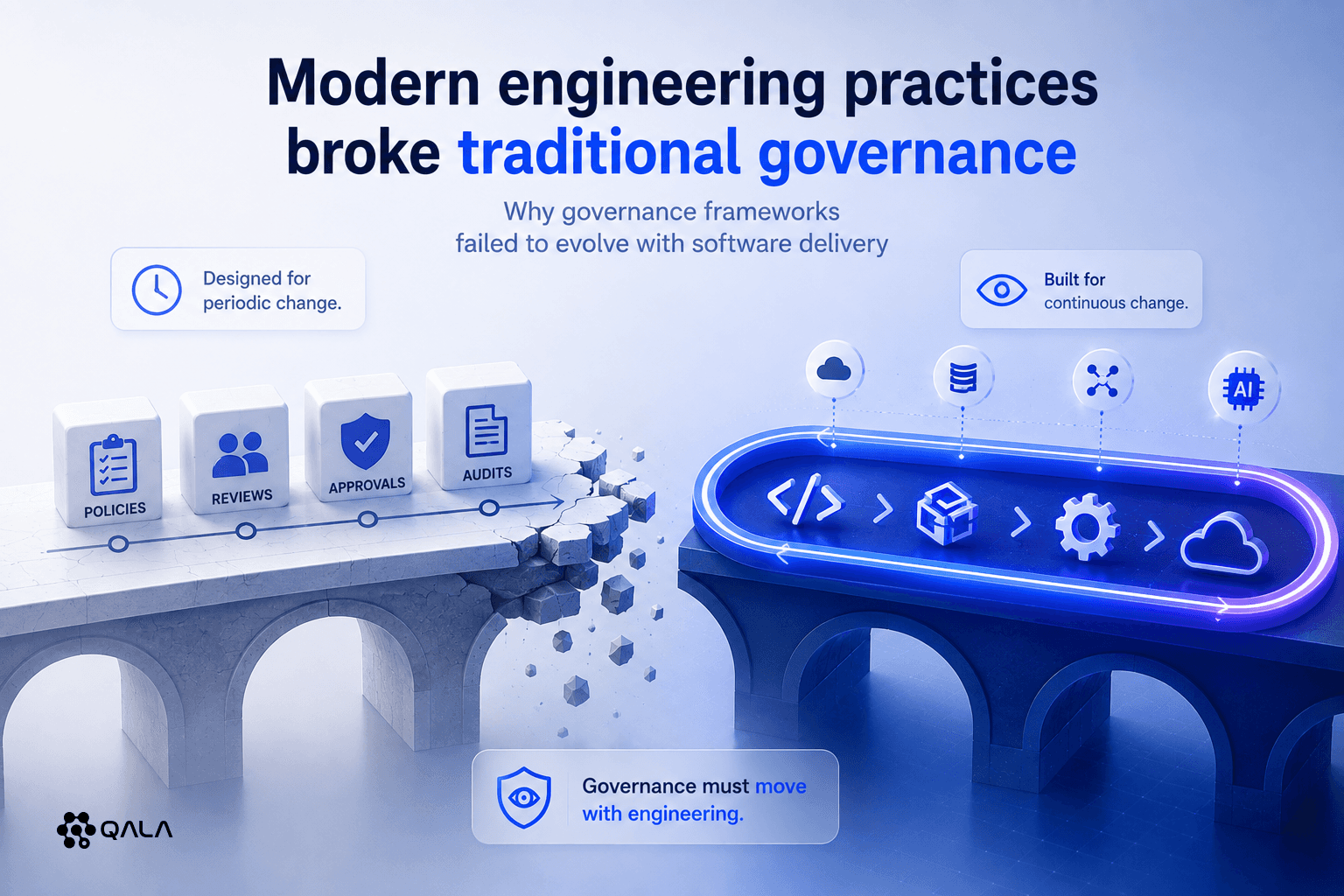
The operational reality of governing modern AI systems
Every organisation is talking about AI governance, some boards are even creating AI steering committees. While risk teams are publishing governance frameworks and updating policies, spreadsheets are tracking approved use cases and new approval processes are emerging across the business.
These are all sensible responses despite being insufficient as AI governance is not fundamentally a policy problem, it is an operational problem.
The challenge today is not the absence of governance structures, but rather the inability to continuously understand how AI is actually being used.
That distinction will define the next generation of governance.
Governance has traditionally been administrative
Governance has relied heavily on co-ordination where committees reviewed proposals, the risk teams assessed the impacts and compliance validated controls. Policies always document expectations and most likely spreadsheets tracked assets.
These mechanisms worked because operational environments changed relatively slowly or within known boundaries, governance had time to catch up.
Governance could remain largely administrative while still maintaining reasonable oversight.
AI changes that equation completely.
AI evolves faster than governance meetings
AI adoption did not happen once, it’s happening continuously with new co-pilots and models appearing, teams experiment. Development teams integrate AI to existing applications and business units connect AI applications to customer data. The same happens with third-party platforms, where almost all vendors release new AI capabilities without organisations actively reviewing or deploying them.
This is making entire workflows evolve in weeks rather than years, while governance often operates on monthly meetings, quarterly reviews or annual policy updates.
The mismatch is obvious.
Operational reality moves every day and governance discussions happen occasionally.
Spreadsheets capture inventory, not behaviour
Many organisations have started building AI inventories, listing approved models, registering AI systems and documenting use cases.
These provide useful administrative oversight but they still lack operational visibility - knowing an AI system exists tells you very little about how it actually behaves.
It does not show:
What sensitive data enters the model
How information moves across connected systems
Which third parties process the data
How prompts evolve over time
Whether operational behaviour still aligns with policy
Inventories describe technology and governance requires an understanding of the behaviour.
Policies define expectations, not reality
The same challenge applies to AI policies as most organisations now have guidance describing acceptable AI usage. Employees are instructed not to submit confidential information, approval processes are documented so the responsibilities are clearly assigned. All of these are essential foundations yet again, policies do not observe behaviour. They don’t verify how AI is being used across thousands of daily interactions, nor can they identify when operational practices gradually drift away from governance expectations.
The fact is that documentation creates consistency and visibility creates governance.
Modern AI governance is a runtime challenge
One of the biggest misconceptions surrounding AI governance is that it can be managed through pre-deployment approval. Increasingly, the real governance challenge begins after deployment when AI systems evolve, new models are launched, integrations expand and users change how they interact with the technology.
Business processes adapt around AI capabilities and with that, risk changes continuously - governance therefore cannot end once approval has been granted, it must continue throughout the operational lifecycle.
This shifts governance much closer to runtime.
The question is no longer "Do we use AI?"
Most of the organisations have already answered that question, the most important questions are now operational:
Which AI systems are interacting with sensitive data?
How is enterprise information moving through AI-enabled workflows?
Where are new AI integrations introducing additional exposure?
How do AI agents interact with existing systems?
Are operational behaviours and runtime paths still aligned with governance policies?
These questions cannot be answered through governance committees, they require continuous operational visibility.
AI governance becomes evidence-driven
Leading organisations are starting to recognise that AI governance requires a different operating model. Rather than relying primarily on declarations, inventories and governance documentation, they must invest in continuous operational evidences:
how AI systems behave,
how sensitive information moves,
that policies remain effective in practice,
that governance assumptions still reflect operational reality.
And this represents a significant shift, governance becomes less about reviewing documentation and more about continuously validating behaviour.
The future of AI governance is operational
The committees will continue to play an important role, the same way policies and frameworks remain essential. None of these disappear but they are no longer enough on their own.
The organisations, teams and the AI era will not be governed through spreadsheets, they will be governed through visibility. This will enable the understanding of how AI is operating, how data moves, and how operational behaviour evolves across increasingly dynamic environments.
AI governance is no longer an administrative exercise, it is an operational capability and the organisations that recognise this first will be the ones best prepared for the future.