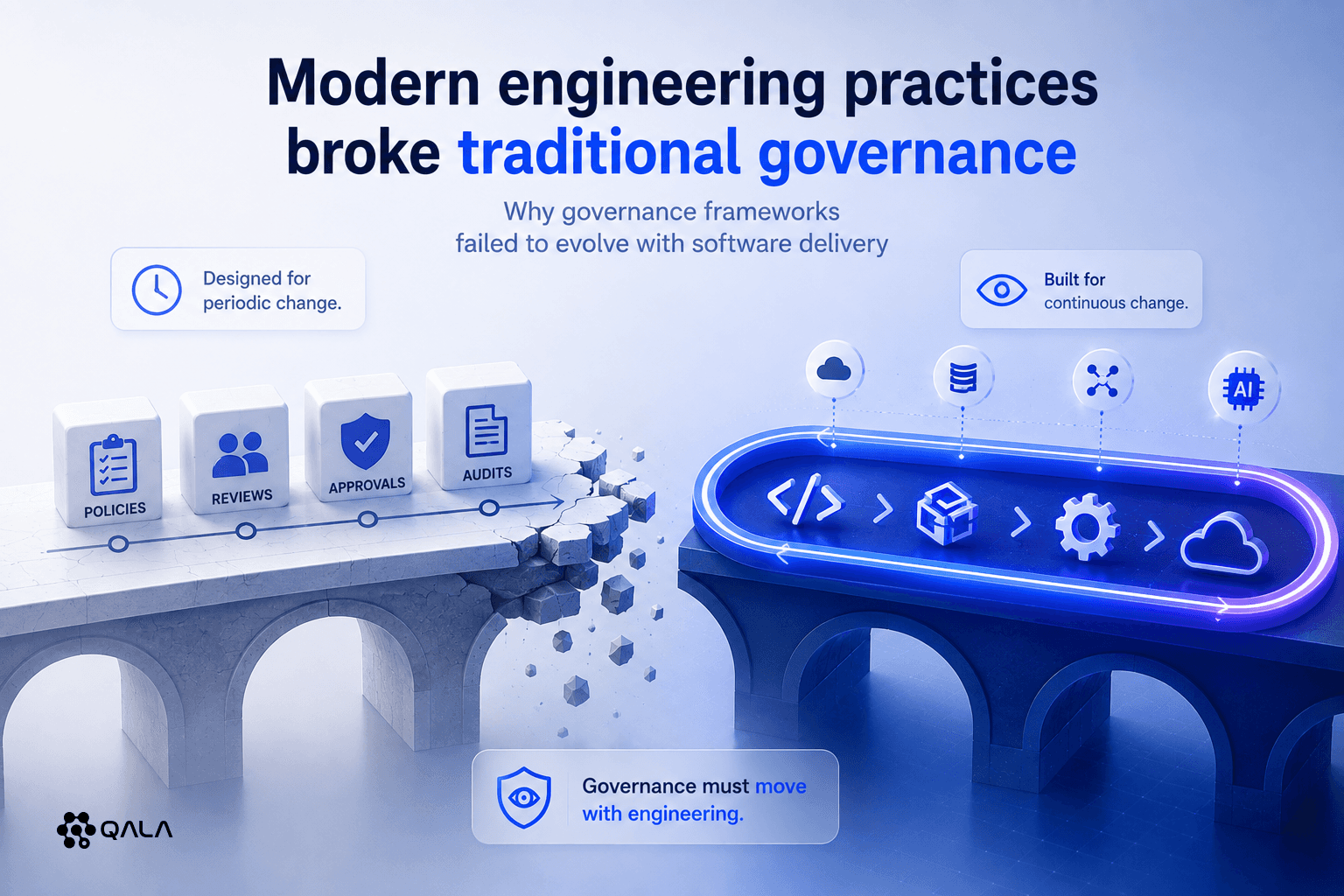
The operational limitations of retrospective governance
For decades, audits have been one of the foundations of governance. They have served as the mechanism organisations rely on to assess compliance, validate controls, and demonstrate accountability. Audits have traditionally provided structure, assurance, and confidence that governance frameworks are functioning as intended.
For a long time, this model worked reasonably well. But the environments organisations operate in today look very different from those governance frameworks were originally designed to manage.
Software is deployed continuously. Infrastructure changes daily. Data moves across cloud platforms, applications, third parties, and increasingly AI-enabled systems. Operational complexity has accelerated to a point where periodic reviews struggle to reflect reality.
This raises an important question:
Can a governance mechanism built around periodic retrospective reviews still provide meaningful assurance in real-time environments? Increasingly, the answer appears to be no.
Audits were built for slower operational environments
Traditional audits are retrospective by design. They evaluate evidence from a defined period in the past. Auditors review documentation, assess controls, examine samples, interview stakeholders, and determine whether governance requirements were met during a specific timeframe.
This approach assumes a relatively stable operating environment.
Historically, that assumption was reasonable. Infrastructure changed slowly. Releases were infrequent. Data flows were easier to understand. Operational change happened at a pace humans could track through manual processes.
Governance cycles aligned with business cycles.
Audits could effectively measure whether controls operated as expected because the environments themselves remained relatively static. That assumption no longer holds.
Modern operating environments are dynamic by default.
The speed of change has outgrown audit cycles
Today, operational change happens continuously. Engineering teams deploy multiple times a day. Infrastructure changes through automation. APIs introduce new system connections. Third-party integrations expand data exposure. AI systems create entirely new workflows and decision paths.
The speed of operational change now far exceeds the speed of governance validation. This creates a structural gap.
An audit may validate that a control existed in March. But what confidence does that provide in June?
A policy may confirm how sensitive data should be handled. But does it reflect how data is actually moving today?
An assessment may show compliance at a point in time. But can it validate continuous operational behaviour?
In highly dynamic environments, governance based on snapshots becomes increasingly fragile. By the time an audit concludes, the environment it evaluated may already have changed significantly.
Retrospective governance creates delayed awareness
One of the biggest limitations of audit-driven governance is timing. Audits often identify issues long after the risk has emerged.
By the time governance teams discover a control failure, the exposure may have already occurred. Sensitive data may already have moved across environments. Misconfigurations may have persisted for months. Operational behaviour may have drifted significantly from documented intent.
This creates a reactive governance model. Issues are discovered after the fact rather than identified as they emerge.
The challenge is not that audits are ineffective. The challenge is that audits are inherently retrospective. They explain what happened. They do not provide visibility into what is happening. That distinction matters more than ever.
Documentation is no longer enough
Many governance programmes still depend heavily on documentation as their primary source of assurance. Policies define expectations. Standards describe controls. Teams complete questionnaires. Audits validate documentation.
These activities remain important but documentation alone does not provide operational truth.
A documented control is not the same as a functioning control.
A declared process is not the same as an operational process.
An attestation is not the same as observable evidence.
Governance increasingly needs to validate operational behaviour directly rather than relying solely on indirect indicators. This requires a fundamental shift in thinking.
Governance must become operational
The future of governance is not about eliminating audits. Audits will continue to play an important role in accountability, assurance, and regulatory oversight.
Audits can no longer be the primary mechanism for governance.
They are becoming one component of governance rather than the foundation of it. Modern governance must become more operational, more continuous, and more evidence-driven.
This means moving beyond periodic assessments and developing the ability to observe operational reality in near real time.
Instead of asking:
Was this compliant during the audit period?
Governance increasingly needs to ask:
Is this compliant right now?
Are controls functioning as expected today?
Can we verify how sensitive data is actually being handled?
These are fundamentally different governance questions and they require fundamentally different governance mechanisms.
The shift towards continuous governance
Leading organisations are already moving in this direction. Security teams increasingly validate controls continuously rather than periodically. Engineering teams rely on observability rather than assumptions. Infrastructure teams measure operational performance in real time.
Governance is beginning to follow the same path. The shift is moving governance from retrospective reviews towards continuous evidence - from declarations towards verification - from assumptions towards visibility.
This transition becomes even more critical in AI-enabled environments, where operational complexity increases significantly and decision-making becomes more dynamic.
As organisations adopt AI, governance must become capable of validating not just technical controls but ongoing operational behaviour.
The future of governance
Governance is evolving and the organisations best positioned for the future will not necessarily conduct more audits. Instead, they will build stronger operational visibility and will reduce dependence on retrospective reviews and increase reliance on continuous evidence.
The future will move from governing documentation to governing behaviour.
Audits will remain important but in increasingly dynamic environments, audits alone are no longer enough.
Because governance built on delayed visibility will always struggle to keep pace with operational reality and organisations cannot govern what they cannot continuously observe.